


Replacing a hybrid battery isn’t automatically the only sensible choice. Your vehicle’s condition, the battery fault and the available repair options all matter when deciding whether to recondition, repair or replace the pack.
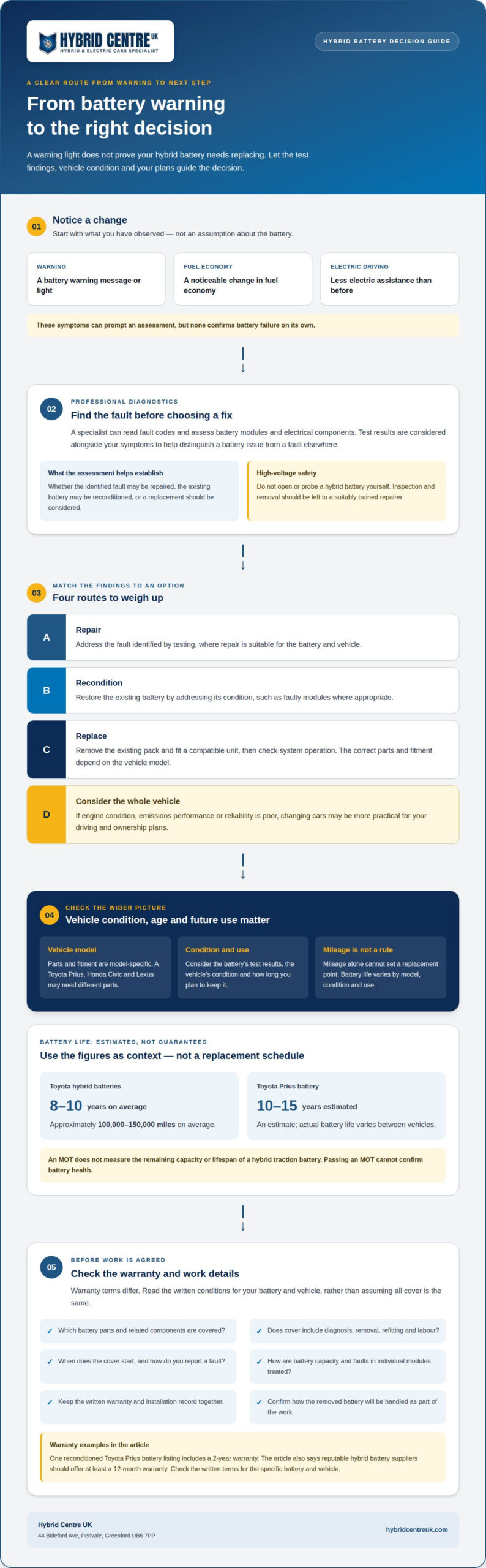
It’s reasonable to weigh that decision against your car’s age, condition and likely future use, especially if a battery warning appears or fuel economy changes. A warning alone doesn’t prove the traction battery needs replacing, so accurate diagnosis matters before you choose a repair.
This guide explains what affects your options, how repair and replacement differ, and what to consider about warranty cover and battery life. You’ll also learn how professional diagnostics can identify the fault and help match the next step to your vehicle.
Key Takeaways
- Battery warnings need proper diagnosis: testing can help identify whether repair, reconditioning or replacement is the right route.
- Choose between battery options by considering the fault, your vehicle’s condition and how long you plan to keep it.
- Read warranty terms for the battery and vehicle carefully, including what work and components the cover applies to.
- Battery life varies with the vehicle and its condition, so mileage alone doesn’t determine when replacement is needed.
Hybrid Battery Repairs and Replacement in London
A hybrid battery warning doesn’t automatically mean the full pack needs replacing. A specialist diagnoses the vehicle and assesses whether repair, reconditioning or replacement suits the fault. Reconditioning restores an existing battery by addressing its condition; replacement involves fitting another pack. The right option depends on test findings, vehicle model and battery condition. A Toyota Prius, Honda Civic and Lexus each require model-appropriate parts and fitment.
Reduced fuel economy may indicate a problem, but it doesn’t identify the cause by itself. A diagnostic assessment helps establish the next step. For UK disposal arrangements, have the removed pack handled as part of the professional replacement process, with its handling included in the work description. This makes clear what happens to the old battery.
In London, account for local travel rules too. According to Transport for London, the ULEZ charges vehicles that do not meet emissions standards £12.50 daily. This charge relates to driving, not battery work. The same assessment approach applies in London and other UK cities, while suitable parts and fitting depend on the vehicle. Don’t open or probe a high-voltage battery yourself; leave inspection and removal to a suitably trained repairer.
Reconditioned or Replacement Hybrid Battery: Which Option Suits You?
A battery warning can point to a traction-battery fault, but other components can cause similar symptoms. Diagnostics help determine whether reconditioning, replacement or changing the vehicle makes practical sense.
Battery Diagnostics and Installation
An inspection can identify fault codes and assess battery modules and electrical components. A warning light alone doesn’t prove the traction battery has failed. Technicians compare test results with symptoms such as reduced fuel economy or less electric driving. A Prius may fall from 55 mpg to 35 mpg or worse. Results help distinguish battery issues from faults elsewhere.
Reconditioning Time and Replacement Process
The time needed for reconditioning depends on test findings and whether technicians can address faulty modules or the pack needs replacement. The process starts with diagnosis, followed by the appropriate repair, battery installation and testing. Replacement involves removing the existing pack and fitting a compatible unit, then checking system operation. Hybrid packs carry high voltage, so trained professionals should handle the work. Consider the whole vehicle too: if engine condition, emissions performance or reliability is poor, changing cars may be more practical for your driving and ownership plans.
Hybrid Battery Warranties: What to Check
Warranty terms differ between manufacturer, used-car and remanufactured battery cover. Before choosing hybrid battery replacement, check which work and components each warranty includes.
Remanufactured Battery Warranties
A reconditioned Toyota Prius battery listing includes a 2-year warranty. Reputable hybrid battery suppliers should offer at least a 12-month warranty. These examples don’t make every warranty identical, so read the written terms for your battery and vehicle model. Check when cover starts, how to report a fault, and whether diagnosis, removal and refitting are included. Ask how the warranty treats battery capacity and faults in individual modules. These details clarify what support applies if the pack develops a problem.
Warranty Coverage
Manufacturer and used-car warranty claims depend on the vehicle and applicable terms. Cover can vary by brand, age, mileage, servicing, battery type and previous work. For a Toyota Prius, check the specific vehicle documents rather than assuming every model has the same battery protection. Confirm whether the warranty covers only the battery pack or related components too, and whether labour is included. Ask how any stated capacity threshold is measured and whether high-voltage system faults are covered. Keep the warranty document and installation record together. Clear written conditions help you understand exclusions, claim steps and the cover period before committing to replacement.
Hybrid Battery Lifespan and Mileage
Hybrid battery life varies by model, condition and use, so mileage alone cannot set a replacement point. Toyota hybrid batteries last around 8 to 10 years on average and cover approximately 100,000 to 150,000 miles on average. A Toyota Prius battery is estimated to last 10 to 15 years. These figures are broad estimates, not a service interval for every vehicle.
Changes in fuel economy, warning messages or reduced electric assistance can prompt an assessment, but none confirms battery failure by itself. Technicians use diagnostics and battery testing to assess pack performance and identify faults before recommending replacement. An MOT does not measure the remaining capacity or lifespan of a hybrid traction battery. Passing an MOT therefore cannot establish that the battery is healthy or show how long it will last.
Ask the technician to explain the test results and how they support the recommendation. Consider the battery’s measured condition alongside the vehicle’s age, maintenance needs and your driving plans. If fuel economy has fallen, explain when the change began and whether it happens consistently. These details help guide diagnostics. Replacement decisions should follow test findings, not a fixed mileage threshold, because battery life and fault patterns vary between vehicles.
Hybrid Car Parts for Different Makes and Models
Hybrid systems differ between manufacturers and models, so the right part depends on the vehicle’s specification. Hybrid Centre UK supplies car parts for hybrid vehicles and supports repairs across different makes and models. A Toyota Prius, Honda Civic and Lexus may each require parts matched to their own battery and electrical systems. Correct identification helps avoid fitting an incompatible component.
Start with the vehicle’s make, model and registration details. These help technicians identify the relevant parts and carry out advanced diagnostics when a fault needs investigation. A battery warning, for example, doesn’t show by itself which component needs attention. Testing can help establish whether the issue involves the hybrid battery or another part of the electrical system.
Parts support can form part of a wider repair rather than a standalone purchase. If a component fault affects vehicle operation, technicians can assess it alongside the battery system and related electrical work. Car servicing can also identify other maintenance needs during the same visit, giving you a clearer view of the vehicle’s condition before you decide what work is needed.
For fleet operators and individual owners, accurate vehicle details and a clear description of symptoms help guide the assessment. The right part is selected for the vehicle and the repair required, rather than relying on a generic match across different hybrid models.
Diagnostics, Mechanical Work and Electrical Work
Advanced diagnostics help technicians read vehicle fault data and investigate a hybrid battery warning. The alert may involve the traction battery or another electrical component, so diagnosis matters before you decide on a repair. Testing assesses battery behaviour and helps identify whether the fault is within the pack or elsewhere, distinguishing battery concerns from symptoms caused by another system.
Electrical work can address wiring or connection faults that affect hybrid operation. The separate 12-volt auxiliary battery is not the high-voltage traction battery. Identifying which system is involved directs the assessment. Technicians can also assess mechanical issues affecting drivability instead of assuming a battery explains every symptom. Car servicing can place battery concerns within a wider vehicle inspection.
After testing, technicians explain the fault and recommend relevant work, such as hybrid battery repair, electrical work or further mechanical investigation. If results point away from the battery, replacing it won’t fix a separate engine or electrical fault. A clear report should connect the test findings to the recommended repair. Technicians then assess vehicle operation after the work, helping you understand how each task addresses the original complaint.
Hybrid Centre UK’s Services for Drivers and Fleets
Hybrid Centre UK supports drivers and fleet operators with hybrid battery work, car servicing, advanced diagnostics and electrical repairs in London. If your vehicle displays a battery warning, diagnostics can help identify the fault and clarify whether battery work or another repair is needed. The team assesses the vehicle’s condition before recommending relevant work.
Hybrid battery repair, refurbishment and replacement suit different battery faults. Testing helps establish which approach fits your vehicle. Electrical work can address faults outside the battery pack, while servicing can cover wider maintenance needs. This joined-up assessment helps you understand which work relates directly to the reported problem.
For a fleet, a clear diagnosis can help you plan vehicle maintenance around operational needs. Share vehicle details and symptoms, such as warning messages or performance changes, so technicians can assess the issue. Individual drivers can also use diagnostics to distinguish a battery fault from another electrical problem.
Hybrid Centre UK also handles mechanical and electrical work alongside hybrid services. Its technicians assess the fault and identify relevant work. Contact Hybrid Centre UK to discuss your vehicle or fleet’s hybrid battery needs.
Frequently Asked Questions
Is a refurbished battery the same as a new pack?
No. A refurbished battery has been used and restored, while a new pack is a newly supplied replacement. The word “refurbished” doesn’t describe the exact work carried out. Ask for the battery’s condition, the work completed and the warranty terms in writing. This helps you understand what is being fitted and how it differs from a new unit.
What affects fitting a reconditioned hybrid battery in London?
Fitment depends on the vehicle’s make, model and battery system, as well as the work identified during assessment. The process involves matching a compatible battery, removing the existing unit and installing the replacement. For a vehicle in London, Hybrid Centre UK can assess the work and explain how the removed battery will be handled. Accurate vehicle details help technicians identify the correct fitment requirements.
Which London garages sell and install reconditioned hybrid batteries?
Hybrid Centre UK provides hybrid battery repair, refurbishment, replacement and fitment in London. Its listed Prius battery options cover Gen 1, Gen 2, Gen 3, Gen 4 and Old Shape models within the stated year ranges. Fitment is available for these listed Prius options. The vehicle’s generation helps identify the appropriate battery and installation route.
How do reconditioned, refurbished and new hybrid batteries compare in reliability?
A reconditioned or refurbished battery has been restored, while a new pack is a different replacement option. The label alone doesn’t establish reliability. Consider the battery’s condition, work performed, testing information and warranty terms. Also check that the unit suits your vehicle. These details give you a clearer basis for comparing options than terminology alone.
What warranty is included with a reconditioned hybrid battery in the UK?
Hybrid Centre UK lists battery warranty options of 6 months, 1 year or 2 years. The applicable option depends on the battery selected. Read its written terms to understand which components are covered, when cover starts and how to report a fault. Check whether installation work has separate terms, as battery cover and fitting cover may not be identical.
How long does a reconditioned hybrid battery last?
There is no single lifespan for every reconditioned battery. Its history, current condition, restoration work and vehicle use all affect how long it remains serviceable. Battery testing can assess its current condition, but it cannot provide an exact end date. Treat general hybrid battery lifespan estimates as context, not as a specific prediction for a previously used and reconditioned pack.