


If your Toyota Prius displays the red triangle, treat it as a warning that needs attention and avoid driving until the fault has been assessed. For red triangle of death Toyota Prius repair in London, diagnosis should identify the cause rather than assume the hybrid battery has failed. Possible causes include a weak 12-volt battery, hybrid battery trouble, an inverter coolant pump fault, or a brake actuator or low brake fluid issue.
It’s understandable to worry about the battery, but the red triangle alone doesn’t identify the failed part. This guide explains when to stop driving, which faults and diagnostic codes may be involved, and how professional diagnosis can distinguish a battery problem from other electrical, braking or engine faults.
You’ll also learn what information helps a technician assess the fault and when advanced diagnostics or hybrid battery repair may be needed. That gives you a clear next step without replacing parts based on the warning light alone.
Key Takeaways
- Treat the red triangle as a warning that needs attention; accompanying lights and dashboard messages can help identify which system needs assessment.
- The warning doesn’t automatically mean the hybrid battery has failed. Codes such as P0A80 or P0A7F can point to a battery fault.
- Hybrid-capable diagnostic equipment can help distinguish battery issues from faults in other vehicle systems.
- Avoid driving with the warning displayed, and don’t disconnect the battery to reset it, as this can erase useful diagnostic evidence.
1. Why does my Prius show the red triangle of death right after I start it?
The red triangle is the Toyota Prius Master Warning Light. It means the vehicle has detected an issue that needs attention. The symbol is a general warning, not a diagnosis of a specific failed part. If it appears when you start the vehicle, that tells you the warning is active, not when the fault began. Further assessment is needed.
Check the multi-information display and any other illuminated warning lights. A message may provide useful context, while another warning can point to the affected system. For example, a red triangle alongside brake and ABS lights may indicate a braking-system concern. The triangle alone cannot distinguish that from an electrical or hybrid-system fault.
A failing brake actuator or low brake fluid can trigger the triangle, often alongside brake and ABS warnings. Take these signs seriously because they involve braking. Don’t assume the car is safe to drive simply because it starts or moves. Avoid driving while the warning is displayed, especially if brake warnings appear or braking feels different.
Note the exact dashboard message and any other warning lights. Tell the technician whether the triangle stays on, appears intermittently or returns after restarting. This information helps relate the warning to the vehicle’s symptoms. A professional diagnosis should retrieve relevant fault information and assess the affected system, rather than treating the triangle as proof that one component needs replacing.
2. Does the red triangle of death always mean my hybrid battery is dead?
No. The red triangle doesn’t prove the hybrid battery has failed. A Prius can show it for faults in other systems, so diagnosis must identify the source. A failing hybrid battery may be associated with codes P0A80 or P0A7F. These codes are useful clues, but they need to be interpreted alongside other scan results and the vehicle’s symptoms.
Toyota dealers and independent garages in London repair Prius hybrid batteries. When choosing a workshop, ask whether it has hybrid-capable diagnostic equipment and can assess the battery, rather than relying only on a basic code reader.
A technician connects a hybrid-capable scanner to retrieve diagnostic trouble codes from relevant vehicle systems. A basic OBD2 reader may not access the hybrid codes needed to investigate a Prius warning. The technician records the codes, checks their descriptions and context, then compares them with available system data and the symptoms you report. This helps distinguish a battery fault from another electrical or hybrid-system issue.
Before booking an assessment for the red triangle, note your Prius model and year, the warning message, any other illuminated lights, and how the car behaves. Tell the technician whether the triangle stays on, the vehicle enters reduced-power mode, or the warning returns after restarting. These details help guide the diagnostic checks.
If the Prius still drives normally, arrange an assessment within a day or two. Don’t disconnect its battery to clear the warning, as this can erase diagnostic evidence. A scan should preserve the fault information before any reset or repair is considered. For a Prius fault that needs a hybrid-capable scan, book advanced diagnostics to identify the cause before deciding on repair.
3. Common causes of the red triangle
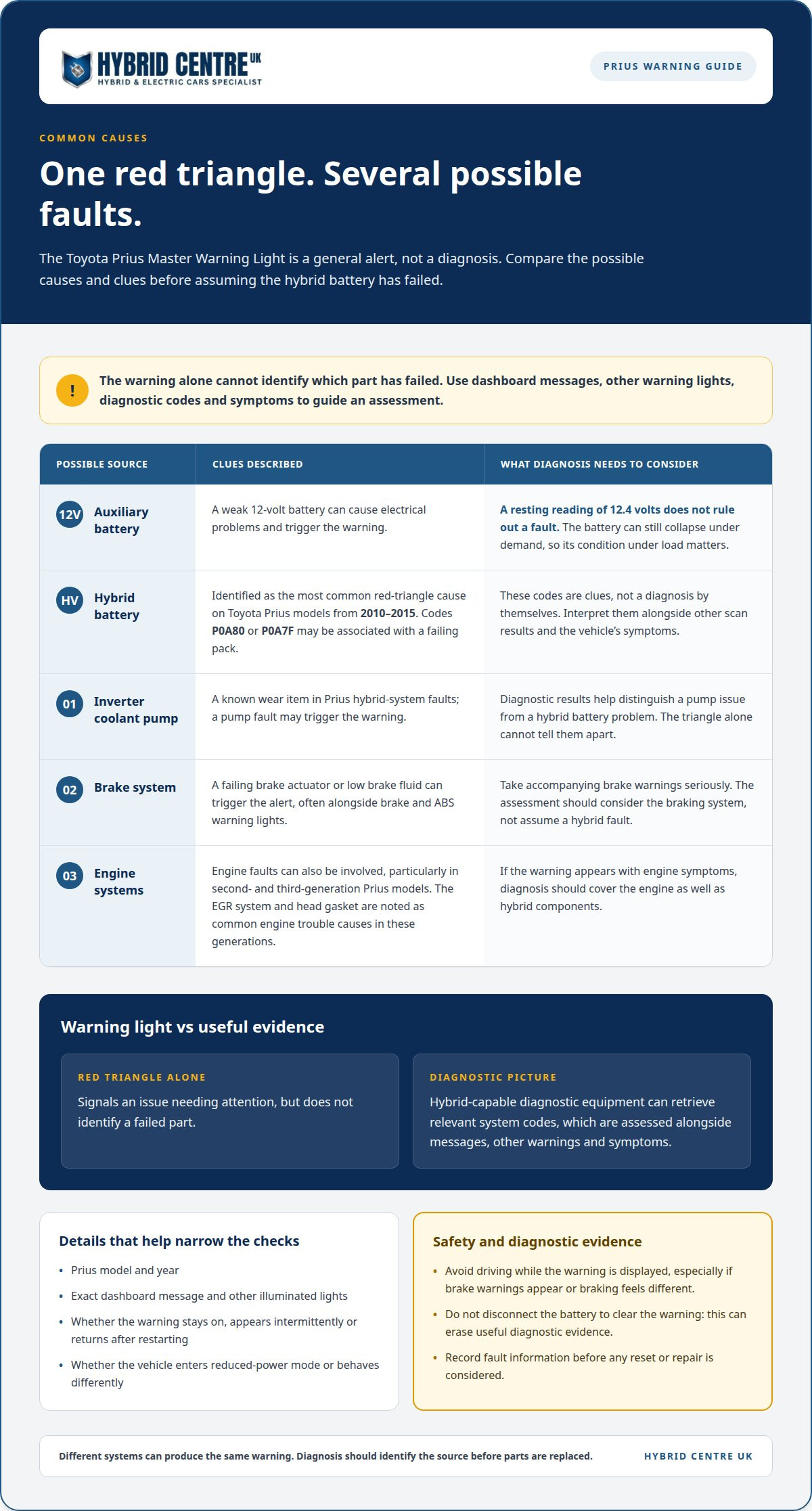
The Prius red triangle can be triggered by faults beyond the hybrid battery. Common possibilities include the 12-volt auxiliary battery, inverter coolant pump and engine systems. These causes affect different parts of the vehicle, so the same warning can have several explanations. The Prius model and its accompanying symptoms help narrow the checks. A diagnostic scan and inspection are needed to match the warning with its source.
A weak 12-volt battery can cause electrical problems and trigger the warning. A reading of 12.4 volts at rest does not rule out a fault, because the battery can still collapse under demand. The battery’s condition under load matters, not just its resting reading. This is one reason a voltage reading alone may not explain why the triangle appeared.
Hybrid battery failure is identified as the most common red-triangle cause on Toyota Prius models from 2010-2015. A failing pack may be associated with codes P0A80 or P0A7F, but those codes need to be interpreted alongside the scan results. They can direct attention towards the battery; they do not make the triangle itself a definitive diagnosis.
The inverter coolant pump is a known wear item in Prius hybrid-system faults, so a pump fault may also be behind the warning. Diagnostic results help distinguish this from a battery issue, rather than treating every hybrid-system warning as proof of battery-pack failure.
Engine faults can also be involved, particularly in second- and third-generation Prius models. The EGR system and head gasket are identified as common engine trouble causes in these generations. If the warning appears with engine symptoms, the assessment should cover the engine as well as hybrid components. The model generation, fault codes and symptoms together help identify the appropriate repair.
4. Hybrid-system trouble codes
A Prius trouble code records a fault detected by a vehicle system. It provides a starting point for diagnosis, not automatic proof that a particular part has failed. The code needs to be considered alongside the dashboard message, other recorded faults and the vehicle’s symptoms. For example, a hybrid-system code should be interpreted in the context of the wider scan.
Hybrid-capable diagnostic equipment can access relevant Prius systems that a basic code reader may not reach. A technician retrieves and records the codes before clearing anything, then checks which systems reported faults. This creates a useful evidence trail and helps distinguish a hybrid-system issue from faults in other vehicle systems.
Code context matters. Several codes may appear together, and one fault can affect how another system behaves. The technician compares the code descriptions and timing with the symptoms you report, such as when the warning appeared or whether the vehicle’s behaviour changed. The aim is to identify the likely cause before deciding what needs further testing or repair.
Don’t disconnect the Prius battery to reset the warning. This can erase diagnostic evidence, and the light may return. Clearing codes before they’re recorded can remove information that helps explain the original fault. Leave the warning history intact for assessment, and tell the technician if you’ve already tried a reset.
Useful details include the exact dashboard message, any other warning lights, and when the triangle first appeared. If a scan has already been carried out, share its code readout rather than relying on a code name alone. The code and symptoms together help guide the next checks. Arrange a Prius diagnostic assessment to investigate the recorded fault before repair decisions are made.
Hybrid Centre UK
Hybrid Centre UK can assess a Prius showing the red triangle in London. Its advanced diagnostics investigate fault codes and symptoms, while electrical work and vehicle service can address issues beyond the hybrid battery. If testing identifies a battery fault, the team can carry out the relevant hybrid battery work.
Bring the Prius warning message and any diagnostic code information you have. Details such as when the triangle appeared and how the vehicle behaved can help explain the problem. Based in Greenford, Hybrid Centre UK supports Prius owners across London, from fault assessment through to repair.
Contact Hybrid Centre UK to discuss your Prius warning and arrange the next step.
Plan the next step for your Prius
After your Prius has been assessed, use the findings to make an informed repair decision. The recommended work should relate directly to the identified fault, and you should understand what each repair is intended to address. Before authorising work, clarify its scope, including whether follow-up inspection or maintenance is part of the plan. This gives you a practical basis for deciding what to do next.
For a Toyota Prius showing the red triangle of death, London repairs should address the diagnosed cause, not simply clear the dashboard warning. Keep the repair record with your vehicle documents, including the work completed and any guidance for ongoing care. If you use the car for work or manage it as part of a fleet, a clear record can help you plan future maintenance. Tell the technician about any symptoms that continue after the repair.
The next step is a clear conversation about the findings and repair plan. To discuss Toyota Prius red triangle of death repairs in London, contact Hybrid Centre UK and decide how to proceed.
Frequently Asked Questions
Is it safe to drive with the red triangle of death?
It’s safest not to drive with the red triangle displayed until the fault has been assessed. If the Prius also shows turtle mode, flashing warnings or makes grinding noises, stop and arrange recovery rather than continuing. A car that still moves may have a fault that needs attention. Note any dashboard message and share it with the technician arranging the assessment.
Can a specialist reset or clear the red triangle of death after diagnosing the fault?
A specialist can clear the warning after recording the fault information and addressing the cause. Clearing it alone doesn’t fix the underlying problem, so the warning may return. A post-repair scan helps establish whether the reported fault remains. Avoid disconnecting the battery beforehand, as this can erase evidence needed to understand what triggered the warning.
Can you keep driving?
Don’t assume the car is safe to continue driving just because it can move. If it otherwise drives normally, arrange an assessment within a day or two. Stop and arrange recovery if the Prius enters turtle mode, warning lights flash or you hear grinding. These symptoms make continuing the journey unwise.
Does the red triangle of death always mean my hybrid battery is dead?
No. A red triangle can relate to faults outside the hybrid battery, so replacing the pack without diagnosis risks addressing the wrong issue. For example, a weak 12-volt battery or an inverter coolant pump fault can also be involved. Codes such as P0A80 and P0A7F may point towards a hybrid battery problem, but technicians interpret them with the full scan results.
Is the red triangle of death covered under warranty?
Not automatically: the warning is a symptom, and coverage depends on the diagnosed fault and applicable warranty terms. Hybrid Centre UK states that its services carry a 12-month or 12,000-mile warranty. Its hybrid battery warranty options are 6 months, 1 year or 2 years. Check which terms apply to the specific repair or battery fitted to your Prius.
Why does my Prius show the red triangle of death right after I start it?
If the triangle appears at start-up, the Prius has detected an issue; that doesn’t mean starting the car caused it. Check the multi-information display for a message and note any other warning lights. For instance, brake and ABS warnings alongside the triangle can direct attention to the braking system. Share these details during the diagnostic assessment.