
An engine management light is a warning, not a diagnosis: it can point to a fault affecting the engine or emissions system, but the symbol alone cannot identify the failed part or show how serious the problem is. If it appears alongside rough idling, stalling or poor acceleration, you need a clear explanation of what the vehicle has detected and what checks are needed before repairs are recommended; engine fault diagnosis in London should go beyond reading and clearing a code. This guide explains what the warning may mean, how diagnostic equipment and hands-on testing help interpret fault codes, and what findings, likely causes and repair urgency a report can cover; it also explains how professional tools can check vehicle computer systems and provide more context than a basic code reader, helping you understand the recommended next step.
Key Takeaways
- Treat an engine management light as a prompt for diagnosis, not as proof that a particular part has failed.
- A useful diagnostic report links test findings to likely causes, recommended repairs and their urgency.
- Professional diagnostic equipment can provide system information that a basic code reader may not show.
- Share the symptoms you’ve noticed so a technician can connect the vehicle’s behaviour with the diagnostic results.
Diagnostic reports and repair recommendations
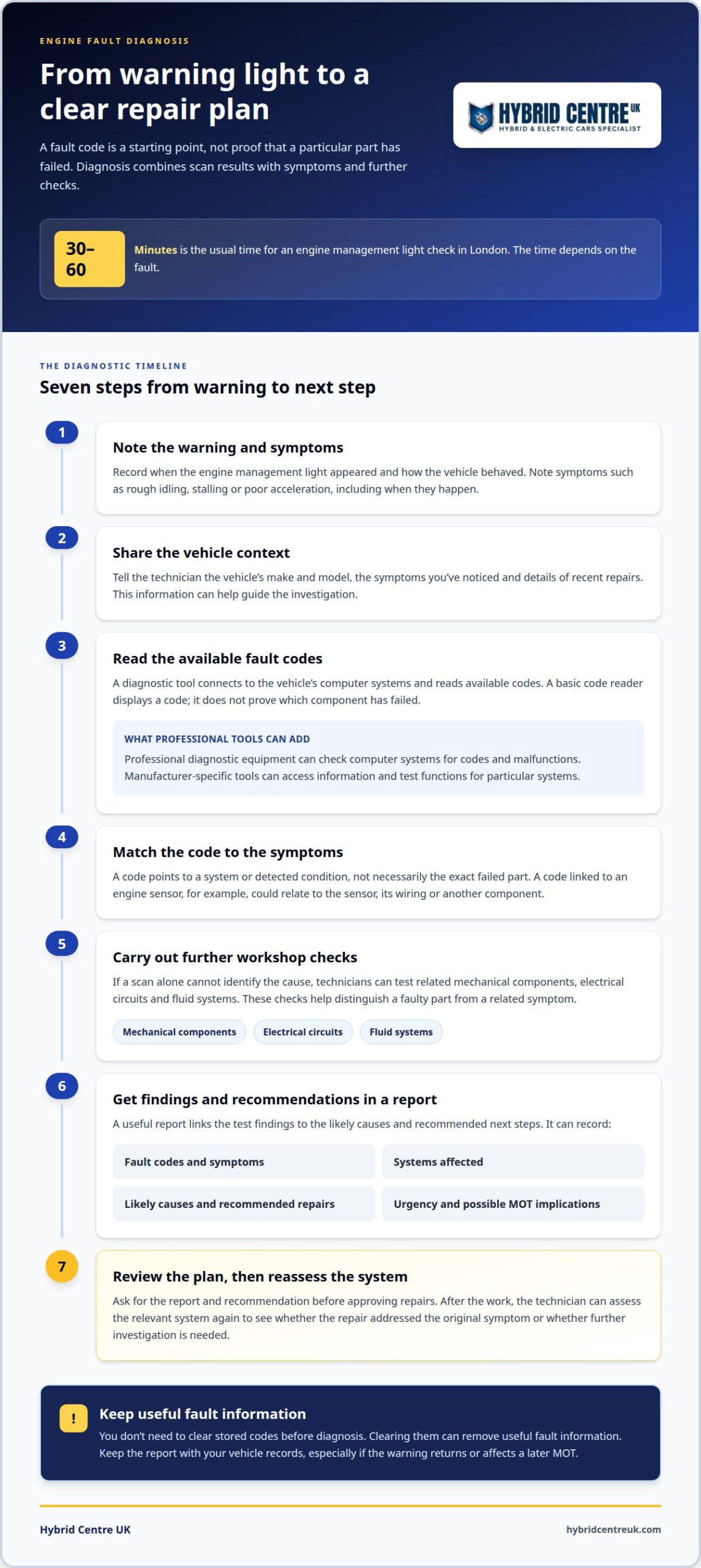
A diagnostic report turns scan results and workshop checks into a repair plan. In London, an engine management light check usually takes 30-60 minutes, depending on the fault.
Diagnostic findings and further tests
A diagnostic report records fault codes, symptoms and the systems affected. It can outline likely causes, recommended repairs, urgency and possible MOT implications. A scan alone may not identify the exact failed component, so further testing can be necessary. Technicians can test mechanical components, electrical circuits and fluid systems alongside computer diagnostics to distinguish a faulty part from a related symptom. Tell them when the warning appeared and how the vehicle’s behaviour changed. These details help guide the next test.
Repair recommendations and garage options
When comparing engine fault diagnosis in London, look for clear reports, explained test findings and repair recommendations tied to those findings. Reviews can indicate whether drivers value clear communication, accurate fault-finding and repairs completed as agreed. A mobile service may suit a vehicle that cannot easily reach a garage, while a local workshop can carry out hands-on checks. Choose a service that explains what the diagnosis covers and how results will be reported, giving you a practical basis for deciding on repairs.
Combining diagnosis with repairs
When diagnosis and repairs take place at the same garage, technicians can use their findings to plan the next step. They can explain which fault needs attention first and whether further checks should come before replacing a part. Ask for the report and recommendation before approving repairs. After the work, the technician can assess the relevant system again to see whether the repair addressed the original symptom or further investigation is needed. Keep the report with your vehicle records, especially if the warning returns or affects a later MOT.
Professional diagnostic tools versus basic code readers
An OBD scanner reads fault codes stored by a vehicle’s computer systems. A basic code reader displays a code but cannot prove which component has failed. Professional diagnostic equipment can check vehicle computer systems for codes and malfunctions, while manufacturer-specific tools can access information and test functions for particular systems. For engine fault diagnosis in London, this broader assessment helps technicians interpret a code alongside the symptoms instead of treating it as a repair instruction.
Electronic fault-code scanning begins by connecting a suitable diagnostic tool and reading available codes. The technician checks which systems reported them and considers the vehicle’s symptoms. A code linked to an engine sensor, for example, could relate to the sensor, its wiring or another component. Further tests help distinguish between these causes. Accurate diagnosis means interpreting scan results alongside test findings, not simply replacing the part named by a code.
Before booking, note when the warning appeared and what the vehicle was doing. Share its make, model, symptoms and details of recent repairs so the technician can plan the investigation. You don’t need to bring a code reader or clear stored codes first, as clearing them can remove useful fault information. Professional engine fault diagnosis in London can combine code reading with further system tests when the reported symptoms call for them.
Insurance or warranty cover for diagnostic work depends on your policy or warranty terms. Check whether fault investigation and related repairs are included, and whether the terms specify where repairs must take place. Don’t assume a diagnostic check is covered automatically. Reviewing the terms can help you understand your options before authorising work.
For system-level testing, advanced diagnostic checks can help identify what needs investigating before repairs begin.
What Does the Engine Management Light Mean?
An engine management light means the vehicle has detected a fault, but the warning alone doesn’t identify its cause. The symbol and any change in performance help technicians decide what to investigate.
Warning light meanings and causes
An engine management light can relate to an engine or emissions-system fault, but it doesn’t prove that a specific component has failed. Other dashboard warnings point to different systems. Direct Motoring Group says an ABS light can indicate trouble with braking sensors, wiring or brake components, while a DPF warning can indicate a blocked diesel particulate filter. Treat each symbol as a prompt to identify the affected system.
Risks of driving with a warning light
Driving without understanding an engine warning can leave a fault unresolved and affect vehicle performance. Note changes such as poor acceleration, rough idling or stalling, and arrange diagnosis rather than assuming the light will clear. An ABS warning relates to the braking system, while a DPF warning relates to the exhaust filter. Take changes in braking or engine behaviour seriously and seek an assessment promptly.
Check engine light diagnosis
Diagnosis starts by reading stored fault codes and matching them to the warning and symptoms. A code points to a system or detected condition, not necessarily the exact failed part. Technicians may then test related electrical circuits, mechanical components or fluid systems. For a DPF warning, diagnostic checks can assess the blockage and guide cleaning or repair recommendations. These findings help determine the appropriate next step.
Signs that call for diagnosis
Arrange an assessment if the engine light appears alongside poor acceleration, rough idling or stalling. These symptoms can help technicians narrow down the investigation. Note when they occur, such as during acceleration or while stationary, and describe any changes you’ve noticed. A separate ABS light, DPF warning or braking concern also indicates a system that needs its own checks. Reporting each warning gives the technician a clearer picture.
What warning signs mean I need an engine diagnostic?
Book an engine diagnostic when a warning light appears with a change in vehicle behaviour. Technicians can investigate poor acceleration, rough idling and stalling. Note when each symptom occurs, such as during acceleration, at idle or after starting. This pattern helps connect your observations with the test results. A fault may affect engine performance, electrical systems, transmission or emissions, so describe every change you’ve noticed.
Electrical symptoms can also warrant testing. Battery drain, charging-system problems and faulty lighting are examples of electrical faults technicians can diagnose. Tell the garage if the vehicle struggles to start, loses electrical functions or has inconsistent lights. For transmission concerns, report gear-selection difficulties or clutch problems. These details help identify which systems need investigation instead of assuming every symptom comes from the engine.
Exhaust and emissions concerns also need attention. A DPF warning can indicate a blocked diesel particulate filter, while a catalytic converter problem can affect emissions. Diagnosis can assess a DPF blockage and guide cleaning or repair recommendations. Report changes in engine response alongside any emissions warning. This context helps technicians select relevant checks and interpret their findings.
Keep a short record before booking. Note the warning symbol, when it appeared and whether it stays on or returns. Include specific examples, such as stalling at junctions or uneven running while stationary, and mention recent repairs related to the symptoms. This information helps the technician focus the investigation on the vehicle’s reported behaviour, but it does not replace testing.
Arrange professional testing when symptoms persist, recur or affect how the vehicle runs. A technician can combine computer checks with tests of mechanical components, electrical circuits and fluid systems. This matters when one warning appears alongside several symptoms, such as rough idling and poor acceleration. The results help separate a recorded fault from the underlying cause and inform the repair recommendation. Book engine diagnostic testing to investigate warning lights and performance changes.
Hybrid Centre UK: Engine Repair
Hybrid Centre UK investigates engine warnings using advanced diagnostics and carries out engine repairs when testing identifies a fault. If another garage has scanned the vehicle, bring the report and describe any changes you’ve noticed, such as stalling or uneven running. This helps connect recorded codes with symptoms and determine whether further checks are needed.
Once the cause is identified, the findings can guide a repair recommendation instead of relying on a code alone. If the issue relates to a hybrid system, Hybrid Centre UK’s Hybrid Battery service may also be relevant. Car Service can address maintenance needs alongside an engine concern, while MOT Service is available when your vehicle needs its MOT.
For help with an engine warning or a confirmed engine fault, contact Hybrid Centre UK.
Plan your next step with confidence
If a warning returns after a repair, keep the repair record and note when the light reappeared. This timeline gives the technician useful context for distinguishing a recurring issue from a different fault. Mention whether the vehicle’s behaviour changed after the work, too.
For hybrid owners, engine concerns can arise alongside battery or general maintenance needs. Hybrid Centre UK offers Hybrid Battery support and Car Service, as well as Advanced Diagnostics, so you can discuss related vehicle concerns in one place. Technicians can use diagnostic findings to guide the next repair decision without treating a warning code as proof of a failed part.
If you need engine fault diagnosis in London, take the next step with the vehicle’s symptoms and any repair records ready. Clear information helps the team understand what you need and discuss a suitable way forward. Contact Hybrid Centre UK to discuss your vehicle’s diagnostic needs.
Frequently Asked Questions
What does engine fault diagnosis include and how does it work?
A clear handover gives the technician a structured basis for deciding what needs attention. Bring any earlier garage report, note when the problem began and explain whether it has changed. For a rental or fleet car, include the driver’s observations. This can help distinguish a fault that happens repeatedly from one reported after a single journey.
Which London garages offer engine fault diagnosis near me?
Hybrid Centre UK offers advanced diagnostics in London. Its workshop is at 44 Bideford Ave, Perivale, Greenford UB6 7PP. If you’re arranging a visit, include your vehicle’s make and model and explain the concern when getting in touch. This gives the team useful context for discussing the diagnostic appointment and the information you should bring.
How long does an engine diagnostic check take?
Appointment length varies with the work arranged and whether the investigation needs to go beyond its initial scope. Describe all related symptoms when booking so the appointment can account for the issue you’ve noticed. Allow time to discuss the findings before deciding whether to proceed with recommended repairs.
Can I drive with the engine management light on in the UK?
A warning alone doesn’t establish whether it’s safe to continue driving. Consider how the vehicle is behaving: stalling, rough running, a marked loss of performance or a braking concern needs prompt attention. If you’re unsure the car is safe to control, stop somewhere safe and arrange assistance. Otherwise, book a professional assessment and follow relevant instructions in your vehicle handbook.
What is the difference between an OBD scan and a full engine diagnosis?
An OBD scan is a readout; a full diagnosis is a workshop assessment that supports a repair decision. If you already have a scan printout, bring it to the appointment so the technician can consider it alongside the vehicle’s history and the issue you’ve reported, then explain a practical next step.