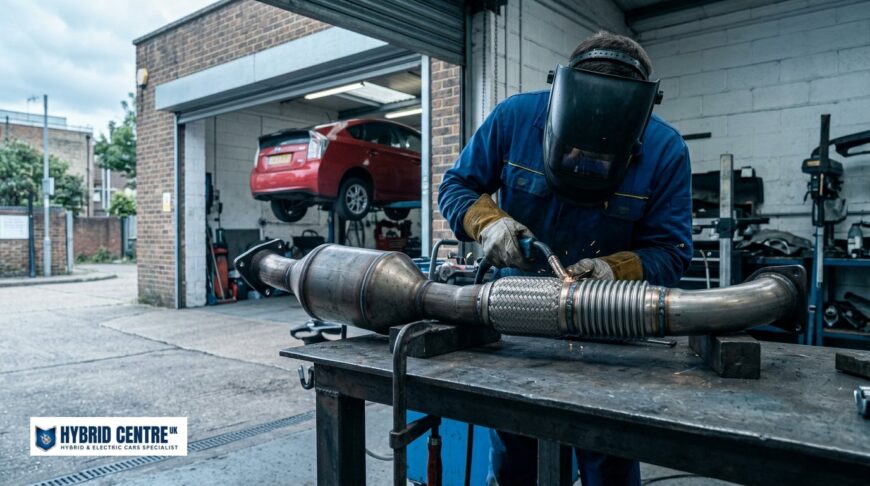

A fault near the exhaust doesn’t always mean the whole front pipe assembly needs replacing. Catalytic converter repair in London may involve fixing a damaged flexi section instead. The catalytic converter helps control emissions, while a diesel particulate filter (DPF) traps soot and, in some systems, clears it by raising the exhaust temperature. Faults in these components can affect how your vehicle runs and passes its MOT.
A problem around the converter does not necessarily mean the complete assembly needs replacing. The fault may be in the surrounding pipework or flexi connector. This guide explains how catalytic converters and DPFs work, what their parts do, and how diagnosis can show whether a flexi-section repair is suitable or the converter itself needs attention.
Key Takeaways
- A fault in the flexi section or nearby pipework may not mean the whole front pipe assembly needs replacing.
- Learn how catalytic converters and DPFs handle different parts of the exhaust and emissions process.
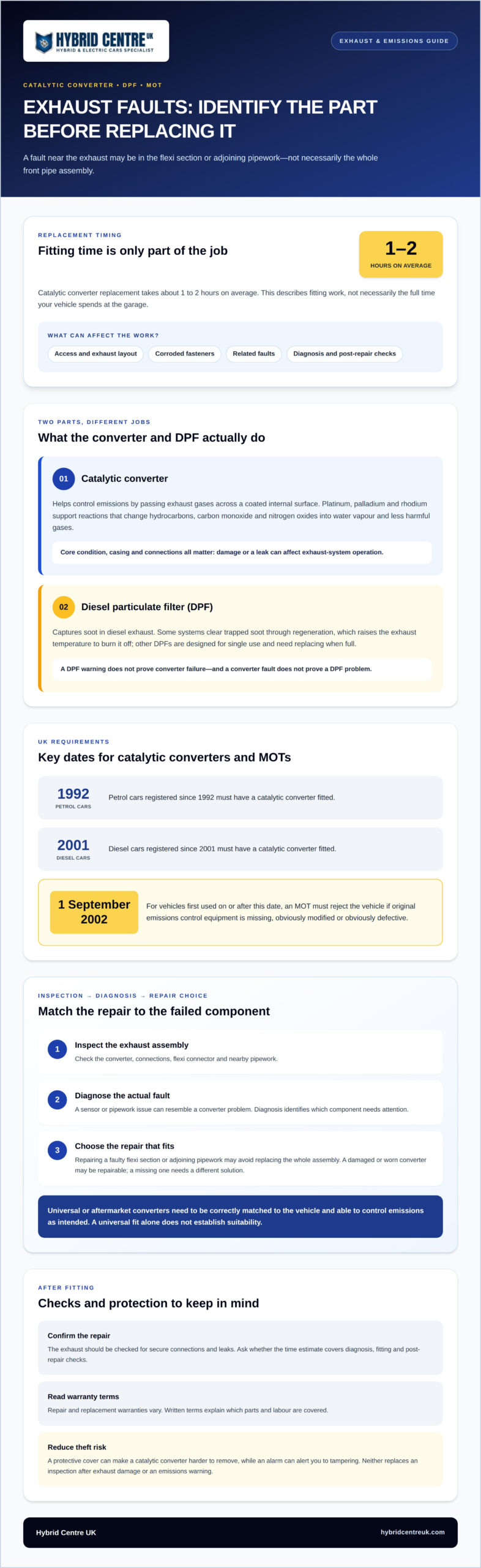
- Catalytic converter replacement takes about 1 to 2 hours on average, though the work depends on the vehicle and fault.
- Understand how UK MOT requirements apply when original emissions control equipment is missing, modified or defective.
Avoiding replacement of the whole front pipe cat assembly
A fault in the flexi section or adjoining pipework may not require replacing the complete front pipe assembly. An inspection can identify whether the converter, a connection or another exhaust component needs attention.
Inspection, repair and replacement options
A technician inspects the exhaust assembly and diagnoses the fault before recommending work. A damaged or worn catalytic converter may be repairable, while a missing one requires a different solution. If the flexi connector or pipework is faulty, repairing that section may avoid replacing the full assembly. For a vehicle in Greenford, diagnosis should establish which component has failed and whether replacement is necessary.
Legal and aftermarket replacement choices
Universal or aftermarket converters can be suitable when correctly matched to the vehicle and able to control emissions as intended. A universal fit alone does not establish suitability or reliability; the component specification and installation matter. According to the UK Government, the MOT rule was amended: for vehicles first used on or after 1 September 2002, an MOT must reject a vehicle if original emissions control equipment is missing, obviously modified or obviously defective.
Replacement timing and garage support
Catalytic converter replacement takes about 1 to 2 hours on average. Access, corrosion, the assembly design and related faults can affect the work involved. London garages can use diagnostics to distinguish a converter fault from a sensor or pipework problem. Repair and replacement warranties vary, so read the written terms for what parts and labour they cover before work begins.
To reduce theft risk in London, a protective cover can make a catalytic converter harder to remove. An alarm can alert you to tampering. These measures help protect the converter, but they do not replace an inspection after exhaust damage or an emissions warning.
Catalytic converter components and operation
A catalytic converter passes exhaust gases across a coated internal surface. Platinum, palladium and rhodium support chemical reactions that change hydrocarbons, carbon monoxide and nitrogen oxides into water vapour and less harmful gases. These metals support the converter’s emissions-control function; they are not simply structural parts of the exhaust.
The converter’s internal core exposes exhaust gases to the catalyst as they flow through the exhaust system. If the core is damaged or worn, the converter may no longer control emissions effectively. The outer casing and connections matter too: physical damage or a leak can affect exhaust-system operation. A fault assessment considers the converter and surrounding components together.
A diesel particulate filter has a separate role. It captures soot in diesel exhaust, then some systems clear the soot through regeneration. A catalyst or engine programme can raise the exhaust temperature to burn off trapped soot. A DPF concern therefore relates to soot collection and clearing, while a converter treats harmful gases. The parts have different jobs, even when they sit in the same exhaust system.
Some DPFs are designed for single use and need replacing when full. Other systems use regeneration to clear soot. The system design affects how a technician assesses a filter concern. A DPF warning does not prove converter failure, and a converter fault does not prove a DPF problem. Identifying the affected component helps direct inspection and repair to the right part.
If an emissions warning needs investigation, exhaust and catalytic converter work can help identify the component involved.
How long does catalytic converter replacement take in London?
A catalytic converter replacement takes about 1 to 2 hours on average. That estimate describes the fitting work, not necessarily the full time your vehicle spends at a London garage. The technician must first identify the fault and confirm which exhaust component needs replacing. If inspection finds a damaged flexi section instead, the work may involve a different repair rather than converter replacement.
Vehicle layout affects access. Some converters are joined to a front pipe assembly, while others have separate connections. The technician needs to reach the relevant joints, remove the faulty part and fit the replacement securely. Corroded fasteners or restricted access can make removal slower. The vehicle’s make, model and exhaust design all affect the work involved.
Related faults can add further steps. A technician may need to assess sensors, pipe connections and exhaust leaks before completing the job. If a sensor must be transferred to the replacement component, it needs careful handling and correct refitting. After installation, the exhaust system should be checked for secure connections and leaks. These checks help confirm that the replacement is fitted correctly.
Ask for a clear explanation of what the garage includes in its time estimate. Does it cover diagnosis, removal, installation and post-repair checks, or only fitting? A fault that appears to involve the catalytic converter may instead be in a nearby pipe or connector. The distinction matters: replacing the wrong component can leave the original problem unresolved.
When arranging a London inspection, share your vehicle’s make, model and symptoms. Mention an illuminated engine warning light, exhaust noise or a recent MOT emissions failure. These details help the technician plan the assessment, but diagnosis determines the repair required. Once the fault and access requirements are understood, the garage can explain the expected work and timing for your vehicle.
Is it legal to remove or replace a catalytic converter in the UK?
Removal rules depend on the vehicle and its original emissions equipment. Every petrol car registered since 1992 and every diesel car registered since 2001 must have a catalytic converter fitted. Replacing a faulty converter is different from removing it and leaving the vehicle without required emissions equipment. The replacement must perform its emissions-control role.
According to the UK Government, the MOT rule was amended: for vehicles first used on or after 1 September 2002, an MOT must reject the vehicle if original emissions control equipment is missing, obviously modified or obviously defective. The MOT also checks the exhaust emissions system. A faulty converter can lead to failure if emissions exceed the limits for the vehicle’s age and fuel type.
Driving on public roads without a required catalytic converter can result in a fine of up to £1,000. If a converter has been stolen or removed, don’t drive the vehicle to a garage. Arrange recovery instead, since driving without it is illegal. This applies especially when the vehicle was built with the component as part of its emissions-control system.
For a replacement, the technician should identify the vehicle’s correct exhaust configuration and fit a suitable converter. A modified or poorly matched component may fail to control emissions correctly. An illuminated engine management light linked to a converter fault is also treated as a major MOT fault. Diagnosis helps distinguish converter failure from a problem elsewhere in the exhaust system.
Keep the MOT outcome and repair details with your vehicle records. If the car fails on emissions, the test result can help identify the area requiring attention, but it doesn’t prove the converter alone is faulty. A garage can inspect the exhaust, assess the emissions concern and explain the repair needed before replacing parts. For compliant exhaust work, book catalytic converter inspection.
Hybrid Centre UK: Exhaust & Catalytic Converter
Hybrid Centre UK carries out exhaust and catalytic converter work for exhaust faults, warning lights and MOT emissions concerns. An inspection can distinguish a damaged flexi section or pipe from a converter fault, so the repair addresses the affected part rather than assuming the whole assembly needs replacing.
Advanced Diagnostics can support fault-finding when a warning light or emissions issue needs further assessment. Share your vehicle’s symptoms and any relevant MOT results so the team understands the concern. If you’re unsure whether the problem involves the converter, DPF or adjoining exhaust, book a professional inspection.
Contact Hybrid Centre UK to discuss your exhaust or catalytic converter concern.
Choose a clear next step for your exhaust fault
Before authorising parts, make sure the diagnosis identifies the component causing the problem. Share any warning lights, changes in exhaust noise and relevant MOT results with the technician. This gives the assessment useful context and helps you understand why a repair or replacement is recommended.
For catalytic converter repair in London, Hybrid Centre UK can assess exhaust concerns using Advanced Diagnostics and explain the next step. Other services include Car Service and Hybrid Battery support, if your vehicle needs attention beyond the exhaust fault. The team can discuss the issue with you and outline the work based on the assessment.
Take the next step when you’re ready: contact Hybrid Centre UK to discuss your repair.
Frequently Asked Questions
What are cats and DPFs?
“Cats” is common garage shorthand for catalytic converters; DPF stands for diesel particulate filter. These terms name separate exhaust components, not a diagnosis. Your vehicle’s handbook or a technician’s inspection can help establish which equipment is fitted. Naming the correct component when describing a warning or fault helps keep the discussion focused on your vehicle’s issue.
What are the signs of catalytic converter issues?
Possible signs include dark exhaust smoke, reduced engine performance, worsening fuel economy, acceleration problems, a sulphur smell or an illuminated check-engine light. Note when symptoms occur and whether several appear together. For example, a change in acceleration alongside a warning light gives the technician useful context. These signs can point to an exhaust or engine-management concern, but they don’t identify the exact cause.
What causes the catalytic converter to wear out?
Age, physical impact and faults that expose the converter to unsuitable operating conditions can contribute to wear. The underlying issue matters: fitting a replacement without addressing a related engine or exhaust fault may leave the cause unresolved. A technician can assess the converter alongside related systems and use the findings to decide whether the component needs repair or replacement.
Who can help with my catalytic converter repair?
Hybrid Centre UK can assess catalytic converter concerns in London. When arranging an inspection, describe the symptoms in your own words and share the vehicle’s MOT result if it has failed. This gives the technician useful context. Ask for the diagnosis and proposed work to be explained clearly, so you understand which component needs attention and why.
Can a faulty catalytic converter affect engine performance?
A catalytic converter fault can be associated with reduced engine performance, acceleration problems or a warning light. These symptoms can also have other causes, so they do not confirm a converter fault on their own. Note when they occur and share that information with a technician, who can assess the converter and related systems.
Will a faulty catalytic converter fail its MOT?
A converter fault can contribute to an MOT failure, but the test result is a useful starting point. Keep the failure report and share its recorded reason with the technician. This helps connect the test finding to the vehicle’s symptoms and guides further assessment. Once the fault is addressed, follow the MOT instructions for resolving the recorded failure.