

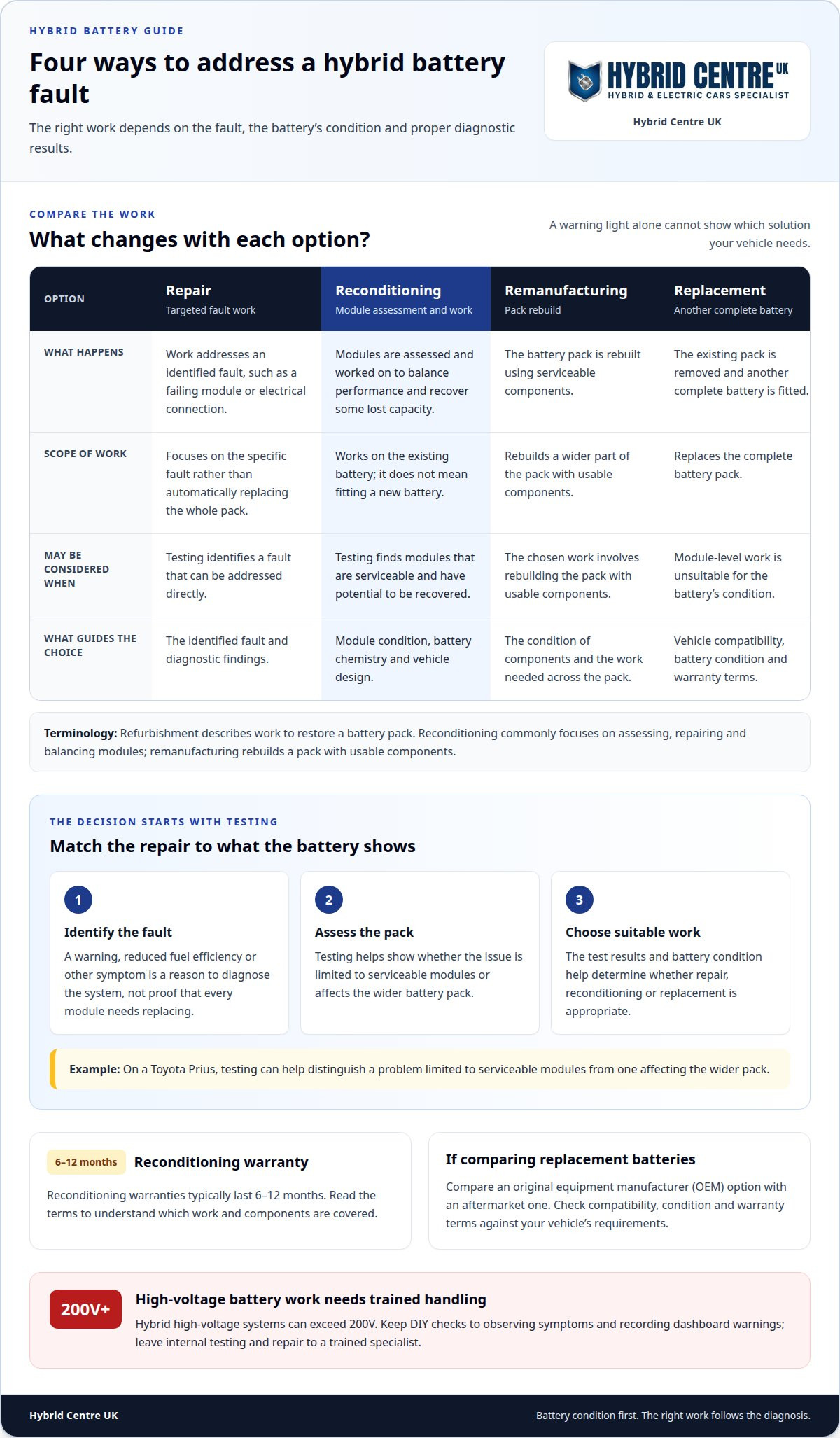
Hybrid battery repair doesn’t always mean fitting a new battery. Reconditioning works on the existing pack, remanufacturing rebuilds it using serviceable components, and replacement installs another battery. The right option depends on the fault, the battery’s condition and proper diagnostic results. A warning light alone doesn’t show which solution is needed.
It’s reasonable to want a dependable repair that restores your car’s performance without replacing parts unnecessarily. A qualified specialist should assess the battery, explain the options clearly and carry out the work with suitable hybrid-vehicle expertise.
This guide explains how reconditioning, remanufacturing and replacement differ, which symptoms can point to a battery fault, and what to look for in a UK hybrid battery specialist. You’ll also learn how advanced diagnostics help identify the issue and when repair may be more suitable than replacing the complete battery.
Key Takeaways
- Learn what to weigh when choosing between an original-equipment battery and an aftermarket option.
- See how refurbishment can involve assessing and working on battery modules, rather than replacing the complete pack.
- Understand what professional testing can reveal across different battery and vehicle systems.
- Find out what relevant high-voltage training means and when specialist electrical work may help.
Hybrid Battery Repair, Reconditioning and Replacement
Repair, reconditioning and replacement are different ways to address a hybrid battery fault. Test results and the condition of the pack help determine which option suits your vehicle.
Repair, Reconditioning and Replacement Options
Hybrid battery repair targets an identified fault, such as a failing module or electrical connection. Reconditioning assesses and works on modules to balance their performance and recover some lost capacity, without installing a new battery. Replacement removes the existing pack and fits another complete battery.
For a Toyota Prius, testing can show whether the problem is limited to serviceable modules or affects the wider pack. Reconditioning may suit a battery with recoverable modules; replacement may be more appropriate when module-level work is unsuitable. When replacing the battery, compare an original equipment manufacturer (OEM) option with an aftermarket one. Check compatibility, condition and warranty terms against your vehicle’s requirements.
Battery Lifespan, Warranty and Vehicle Value
There is no single lifespan for a repaired or reconditioned battery. Continued performance depends on the condition of the remaining modules and how the pack performs after the work. A hybrid battery repair record can help you explain the work to a future buyer, but it cannot guarantee a particular resale value.
Reconditioning warranties typically last 6-12 months. Read the terms to understand which work and components they cover. A repair does not by itself establish whether the manufacturer’s warranty applies; the original terms and service records matter. Keep the diagnosis and work details with your vehicle documents, especially if you later sell the car.
Hybrid Battery Reconditioning and Remanufacturing
Refurbishment describes work to restore a battery pack, while reconditioning commonly focuses on assessing, repairing and balancing its modules. Remanufacturing involves rebuilding a pack with usable components. The exact work depends on the battery chemistry, module condition and vehicle design. The useful distinction for owners is whether the work addresses a limited fault or rebuilds a wider part of the pack.
A typical process starts by testing the pack and identifying weak or mismatched modules. Technicians then assess whether individual modules are suitable for repair, replacement or balancing. Balancing brings module performance closer together, rather than treating the battery as a set of unrelated cells. A warning message or reduced fuel efficiency is a reason to diagnose the system, not proof that every module needs replacing.
Reconditioning time depends on the test results and balancing process. Battery cell balancing may take several hours or multiple charge cycles. Module specifications also vary by model: a Prius prismatic nickel-metal hydride (NiMH) module has six cells in series. This illustrates why replacement modules must match the vehicle’s battery design and chemistry.
Collection and return involve practical handling as well as battery work. For off-vehicle reconditioning, the pack must be removed, transported, assessed, returned and refitted. The sequence and turnaround depend on the vehicle and work required, so they should not be assumed to be the same for every pack.
After reconditioning, testing checks whether the modules work together and whether the pack operates as expected. A change in mileage or a continuing dashboard warning can signal that further diagnosis is needed. If your vehicle needs battery assessment or refurbishment, explore hybrid battery services.
Advanced Diagnostics for Hybrid Batteries
A hybrid vehicle’s battery warning, reduced electric range, poor acceleration or increased fuel consumption can point to a fault. Other signs include failure to charge, reduced energy recuperation or difficulty starting. These symptoms can have different causes, so a warning alone cannot identify which component needs attention.
Professional battery diagnostics combine fault-code readings with checks of the battery pack and its operation. A workshop diagnostic device can display an error linked to a defective traction battery. Technicians can then assess module behaviour, charge response and available capacity to determine whether the fault lies in the battery or another part of the hybrid system.
A dashboard message or basic code reader can help you spot a problem, but it cannot assess every module or confirm the cause. NiMH and lithium batteries use different chemistries, so diagnostic procedures and tests must suit the pack fitted to your vehicle. The aim is to identify the fault accurately before deciding whether repair can restore normal operation.
Hybrid and electric vehicles both need battery testing, but their systems differ. A hybrid battery works alongside a combustion engine, while an electric vehicle relies on its battery for propulsion. A technician interprets battery data in the context of the vehicle, rather than treating one fault code as a complete diagnosis.
DIY assessment should stop at observing symptoms and recording dashboard warnings. High-voltage systems in hybrid vehicles can exceed 200V, making access to the battery pack unsuitable for untrained handling. Opening the pack or attempting repairs risks electric shock and further damage. Leave internal testing and repair to a trained specialist.
Electrical Work and Hybrid Battery Technician Qualifications
Hybrid battery work involves electrical systems as well as individual modules. A specialist needs to interpret test results, identify electrical faults and work safely around high-voltage components. Appropriate expertise matters for both hybrid and electric vehicles, as each has systems that require specific knowledge.
Look for relevant high-voltage training and qualifications that cover removing and replacing electric-vehicle powertrain components. City & Guilds Level 3 includes training for removing and replacing components in an electric vehicle’s high-voltage powertrain and ancillary systems. IMI TechSafe is another credential name to look for when assessing a technician’s training. Check that experience matches the work, such as battery testing, electrical fault-finding and component replacement.
Experience also counts. A useful benchmark for a hybrid and electric vehicle specialist is 20+ years of general automotive experience and 5+ years working specifically with hybrid and electric vehicles. These figures are experience recommendations, not a substitute for relevant training. Ask for a clear explanation of the diagnostic findings and the proposed work, including which electrical components need attention.
Good practice includes isolating the relevant system, following the vehicle’s procedures and using suitable test equipment. A hybrid warning might relate to the battery, wiring or another electrical component, so replacing modules without testing can miss the underlying fault. Clear records of the diagnosis and completed work help you understand what was repaired and support later servicing.
Choose a specialist who can explain the test results in plain English and connect them to the repair plan. For practical help with hybrid electrical work, arrange an assessment before deciding on replacement.
Hybrid Centre UK’s Hybrid Battery Services
Hybrid Centre UK provides hybrid battery work, advanced diagnostics, electrical work and car servicing for drivers dealing with battery faults or warning messages. Turn to the team when your hybrid’s performance changes, a warning appears on the dashboard, or you need a clearer diagnosis before deciding on repair or replacement.
Advanced diagnostics help identify whether a fault relates to the battery pack or another part of the vehicle’s electrical system. The findings guide the next step, whether that means further testing, battery repair or replacement. This helps avoid treating every warning as proof that the complete battery needs changing. You can discuss the results and available work in practical terms before proceeding.
Hybrid battery services cover repair, refurbishment and replacement. The suitable option depends on the battery’s condition and the diagnostic findings. Hybrid battery work carries a 12-month / 12,000-mile warranty. Ask for the warranty terms alongside a description of the work, so you understand what it covers and have a clear record of the service.
Electrical work can address faults affecting the vehicle’s electrical systems, while hybrid car servicing supports routine maintenance. These services can be useful when battery symptoms occur alongside other concerns, or when you want the vehicle assessed as a whole. The team can consider symptoms and test results together to distinguish a battery issue from a separate electrical or servicing need.
Bring your vehicle in for assessment if a warning appears, fuel consumption increases or performance changes. Share any warning messages and describe when they occur, such as during starting or driving. This context helps technicians with their diagnostic work. To discuss hybrid battery repair, replacement, diagnostics or electrical work, contact Hybrid Centre UK about your vehicle’s needs.
Take the Next Step with Confidence
Choosing a repair route starts with understanding what the battery tests show and how the fault affects your vehicle. Before agreeing to work, make sure you understand the proposed repair, what it covers and how the warranty applies. A clear record of the diagnosis and completed work can also help explain the vehicle’s maintenance history later.
For hybrid battery repair, the most useful next step is an assessment of the battery and the vehicle’s wider condition. Hybrid Centre UK’s technicians can help you understand the findings through advanced diagnostics, with car servicing available if your vehicle needs broader attention. This gives you a practical basis for deciding what work to proceed with, rather than choosing a replacement before identifying the fault.
If your hybrid has a battery warning, changing performance or another concern, take the next step at a pace that suits you. Contact Hybrid Centre UK to discuss your vehicle and arrange the appropriate support.
Frequently Asked Questions
What tools are required for hybrid battery reconditioning and repair?
Specialist battery work requires vehicle-compatible diagnostic equipment and tools suited to the battery design. Technicians use test equipment to assess the pack, while reconditioning may involve equipment for charging and balancing modules. High-voltage work also requires appropriate safety procedures. These are not routine home repairs: opening a battery pack without relevant training can expose you to dangerous voltage or damage components.
Can a hybrid battery be repaired or does it need replacing?
A hybrid battery can sometimes be repaired, so replacement isn’t automatic. The decision depends on the test findings and how widely the fault affects the pack. For example, a fault limited to one component may allow targeted work, while wider deterioration can make replacement more suitable. A technician can explain which findings support the recommendation and what the work involves.
Can hybrid battery work be combined with a routine car service?
Hybrid battery work and a routine hybrid car service address different needs, although both may be relevant during the same period of ownership. A service does not replace battery testing, and battery work does not cover routine maintenance. If your vehicle is due for servicing and also showing a battery warning, describe both concerns when arranging attention so they can be assessed appropriately.
What information should I record before arranging an assessment?
Note the exact dashboard warning, when it first appeared and the conditions in which it occurs, such as starting or accelerating. Record any changes in the vehicle’s behaviour and gather its service history, including previous battery work. These details give the technician useful context alongside diagnostic data and can help distinguish a recurring fault from a new problem.
Where can I find a reputable hybrid battery repair specialist in the UK?
Hybrid Centre UK provides battery repair, refurbishment and replacement, supported by advanced diagnostics. Look for a specialist who can explain the test findings, outline the proposed work and provide clear warranty terms. Relevant high-voltage expertise and experience with your vehicle’s battery type are useful indicators. You should leave understanding what was assessed and how the recommended work relates to the fault.