


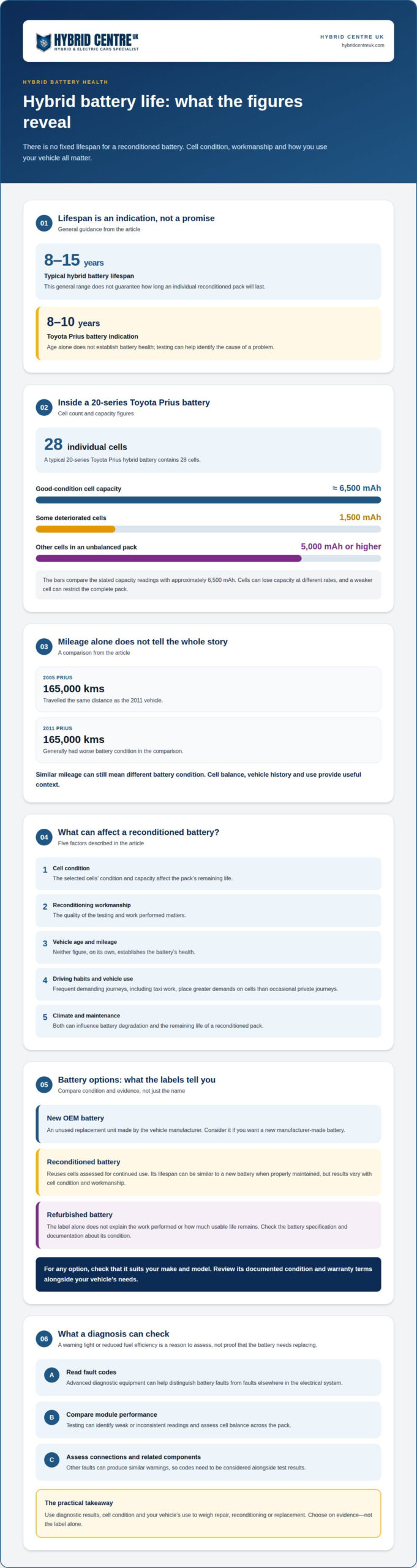
There’s no fixed answer to how long a reconditioned hybrid battery lasts. Its lifespan depends on cell condition and the quality of the reconditioning. With proper maintenance, a reconditioned battery may last a similar time to a new one, but results vary. Understanding what affects battery life and getting a diagnosis can help you decide whether repair, reconditioning or replacement is appropriate.
Key Takeaways
- Compare a new battery with a reconditioned option by weighing cell condition, refurbishment quality and your vehicle’s needs.
- Recognise changes in battery performance that may point to degradation and the need for further assessment.
- See how cell balance and capacity can affect battery health and hybrid performance.
- Use advanced diagnostics to help distinguish a repairable fault from one that calls for battery replacement.
What factors can impact the lifespan of a hybrid car battery?
A reconditioned battery can last a similar time to a new one when properly maintained, but cell condition and workmanship matter. Hybrid batteries typically last 8 to 15 years; this general range does not guarantee the lifespan of an individual reconditioned pack.
Factors affecting reconditioned battery lifespan
Vehicle age, mileage, driving habits, climate and maintenance all influence battery degradation. Frequent, demanding use, such as taxi work, can place greater demands on cells than occasional private journeys. These factors affect a reconditioned pack’s remaining life, not just its original age.
Battery lifespan and replacement timing
Consider replacement when warning lights appear or performance changes persist. A Toyota Prius battery may last around 8 to 10 years, but age alone does not establish battery health. Testing can help distinguish battery deterioration from another vehicle fault.
Reconditioned and refurbished battery lifespan
The labels “reconditioned” and “refurbished” don’t, by themselves, tell you how much usable life remains. A properly maintained reconditioned battery may last a similar time to a new one, but results depend on the cells selected and the work performed.
Battery quality and lifespan
Battery quality depends on cell condition, testing and the reconditioning process. A pack made with carefully assessed cells differs from one with uneven or weakened cells. A diagnostic assessment can help determine whether repair or replacement suits your vehicle.
| Option | Lifespan indication | Key consideration |
|---|---|---|
| New | Hybrid batteries typically last 8 to 15 years | Overall battery health |
| Reconditioned | Can be similar to new when properly maintained | Cell condition and workmanship |
| Refurbished | Varies by pack | Testing and quality of cells |
Choose based on diagnostic results, cell condition and how you use your vehicle, not the label alone.
Difference Between New and Refurbished Hybrid Batteries?
A new OEM battery is an unused replacement unit made by the vehicle manufacturer. A reconditioned battery reuses cells assessed for continued use. The practical difference is the battery’s history: a new unit has not been in service, while a reconditioned pack has. Either option must suit your hybrid’s make and model.
“Reconditioned” and “refurbished” describe restored batteries, but the terms alone don’t explain what work was done. Review the battery specification and any documentation about its condition. Driving habits and vehicle use also affect battery degradation. Frequent stop-start journeys or regular intensive use place different demands on a battery than occasional private driving, whatever type you choose.
An OEM option may suit you if you want a new battery made by the vehicle manufacturer. A reconditioned unit may suit your vehicle if the pack meets its requirements. Check that the replacement is intended for your model and review its warranty terms. A warning light or change in fuel economy calls for diagnosis, not an assumption that either battery type is automatically the answer.
For a Toyota hybrid, consider how long you plan to keep the car and how you use it. Check the replacement specification against your vehicle, then weigh the battery’s documented condition and warranty against your ownership plans. This gives you a practical basis for choosing between new and reconditioned without relying on the label alone.
Battery cell balance and capacity
A typical 20-series Toyota Prius hybrid battery contains 28 individual cells. Each cell has an approximate capacity of 6500 mAh when in good condition. Capacity describes how much charge a cell can hold, so reduced capacity can limit the pack’s usable energy. Hybrid cars rely on cells working together, not just on the total number of cells.
Cells can lose capacity at different rates. Some hybrid battery cells may deteriorate to 1500 mAh, whilst others in an unbalanced pack may still reach 5000 mAh or higher. This difference can affect how consistently the battery stores and supplies charge. The weaker cell can restrict the performance of the complete pack, even if other cells retain more capacity.
Capacity readings need context. A comparison of a 2005 Prius and a 2011 Prius found both had travelled 165,000 kms, yet the 2011 vehicle generally had worse battery condition. Mileage alone therefore cannot explain battery health. Cell condition, balance and vehicle history help show why similar journeys can leave Toyota vehicles with different battery performance.
Uneven cell performance can affect how a hybrid battery assists the engine and supports fuel efficiency. A technician can assess individual cell readings and compare their balance across the pack. Those findings help determine whether repair or replacement is more suitable. If you’re considering a replacement, review its warranty terms alongside its stated condition and capacity. A warranty doesn’t replace an assessment of the battery’s current health.
Hybrid battery diagnosis and repair
A warning light or reduced fuel efficiency can point to a hybrid battery fault, but neither proves the battery needs replacing. Advanced diagnostic equipment can read fault codes and help distinguish battery problems from faults elsewhere in the electrical system. A clear diagnosis helps avoid unnecessary battery replacement and identify the cause.
Testing can compare module performance and identify weak or inconsistent readings across the battery pack. A technician can also assess whether connections or related components contribute to the fault. This matters because a failing module can affect the pack’s operation, while other faults may produce similar warnings. Fault codes need to be interpreted alongside test results.
Driving habits and vehicle history add useful context. Frequent, demanding journeys place different demands on a hybrid battery than occasional driving. A technician can assess how the fault develops during operation and compare that behaviour with diagnostic results. This helps establish whether performance changes relate to battery degradation or another system.
Repair may be appropriate when testing identifies a fault that can be addressed and the remaining battery condition supports continued use. Replacement may be more suitable when deterioration affects the wider pack or repair cannot restore reliable operation. A fault code alone cannot determine the right option. Diagnosis should connect the warning, module readings and vehicle symptoms before any work is recommended.
The key takeaway is simple: choose repair or replacement based on measured battery condition, not a dashboard warning alone. An evidence-led assessment can also reveal whether an engine or electrical fault, rather than the battery, explains reduced fuel efficiency.
Hybrid battery replacement, parts and vehicle work
Replacement may be appropriate when test results show deterioration that cannot practically be repaired. Before fitting a battery, technicians match it to your vehicle’s make and model and inspect related connections. This helps distinguish a failed battery from a connection fault or an unsuitable part. For example, a Toyota Prius needs a battery suited to its specific configuration.
Hybrid car parts support more than battery replacement. A fault may involve a battery component, wiring or another electrical system, so diagnosis guides the choice of part. Matching the part to the vehicle helps address the identified fault rather than replacing components without a clear reason.
Electrical work can include examining connections and related systems that affect battery operation. Mechanical issues can also influence how a hybrid behaves, so technicians assess the wider vehicle when symptoms point beyond the battery. This is particularly relevant if a warning light remains after battery work or the vehicle’s performance changes.
A hybrid battery replacement service should link the test findings, selected part and work carried out. Assessment establishes whether repair or replacement is suitable, while checks of related mechanical and electrical systems can identify other faults. Base the decision on your vehicle’s diagnosis and the battery’s condition, not on a warning light alone.
Hybrid Centre UK: Hybrid Battery
Hybrid Centre UK can assess your hybrid battery in London if warning lights appear, performance changes or battery degradation affects everyday driving. Advanced Diagnostics helps identify whether the fault is within the battery or another vehicle system. The findings give you a clearer basis for deciding what work is appropriate.
If testing points to a battery fault, Hybrid Centre UK can carry out hybrid battery repair or replacement, depending on the results. Cell condition, battery performance and your vehicle’s symptoms all inform the decision. A warning light alone does not establish that the complete battery needs replacing.
Related electrical faults can also affect how a hybrid operates. Electrical work can investigate problems with vehicle systems and connections, while vehicle service supports wider maintenance needs. If battery symptoms appear alongside other changes in vehicle behaviour, assessing both areas can help identify the cause rather than focusing on one symptom.
Arrange an assessment if warning lights persist, performance drops, or you’re unsure whether a reconditioned battery remains suitable. For drivers in London and West London, diagnostic findings can guide the next step, whether that involves battery work, electrical checks or a vehicle service.
Contact Hybrid Centre UK to discuss your hybrid battery concerns.
Frequently Asked Questions
Is It Worth Replacing a Hybrid Battery?
Replacement can make sense when diagnostics confirm battery failure and the rest of your car remains suitable for continued use. Consider the vehicle’s condition, how long you expect to keep it and whether the fault affects normal driving. For example, a battery problem in an otherwise dependable Toyota Prius may justify repair or replacement. Testing helps establish whether the battery is the cause before you decide.
How long does a reconditioned hybrid battery typically last in the UK?
There’s no fixed lifespan for a reconditioned hybrid battery in the UK. How long one lasts depends on the cells used, the reconditioning work, and how the vehicle is driven and maintained. Treat any lifespan estimate as specific to that battery, not as a standard for every hybrid. When comparing options, ask about the battery’s condition and test findings.
What mileage can a reconditioned hybrid battery last?
There’s no mileage limit that applies to every reconditioned battery. Its remaining distance depends on cell condition, driving demands and the vehicle’s existing mileage. A car used for frequent, high-mileage work may place different demands on its battery from one driven occasionally. Testing can establish the battery’s current condition, but mileage alone cannot predict exactly how far it will continue to operate.
What factors affect the lifespan of a reconditioned hybrid battery?
Cell condition and the quality of reconditioning affect how long a reconditioned battery remains usable. Vehicle age, driving frequency, climate and maintenance also influence degradation. For example, intensive taxi use places different demands on a pack than occasional private journeys. Follow the manufacturer’s vehicle maintenance instructions, and have persistent battery warnings assessed rather than assuming they point to a specific fault.
What should I know about reconditioned hybrid battery replacement in the UK?
Start by identifying your vehicle’s make, model and battery type, since replacement requirements differ between hybrids. The battery’s condition and diagnostic findings help establish the appropriate work. For a Toyota Prius, the generation also matters when matching a replacement battery. Use these details to understand which option suits your vehicle, rather than assuming one specification applies to every hybrid.
What warranty do UK suppliers offer on reconditioned hybrid batteries?
Warranty terms vary by supplier and battery option. Hybrid Centre UK lists battery warranty options of 6 months, 1 year or 2 years. Check which period applies to the specific battery and what the warranty covers, including any conditions. These battery warranty options are separate from the business’s stated service warranty, so don’t assume one automatically applies to the other.