
A dashboard warning or a window that stops working doesn’t always point to a failed part; the fault may lie in the wiring, fuse or component, so accurate diagnosis comes first. For car electrical repairs in London, the work depends on the symptoms and what testing reveals, whether your vehicle runs on petrol or diesel or has a hybrid system. This guide explains common electrical faults, how technicians diagnose and repair window and other electrical problems, what shapes the work involved, and when specialist mechanical or electrical attention can help get your car back to reliable running.
Key Takeaways
- Learn which services an auto electrician may handle, from electrical fault-finding to hybrid vehicle care.
- Understand why dashboard warnings and fault codes need proper testing before parts are replaced.
- See how technicians approach common mechanical and electrical faults in petrol and diesel cars.
- Find out what to look for in a garage for hybrid or electric vehicle repairs, and when specialist diagnostics can help.
What does an auto electrician do?
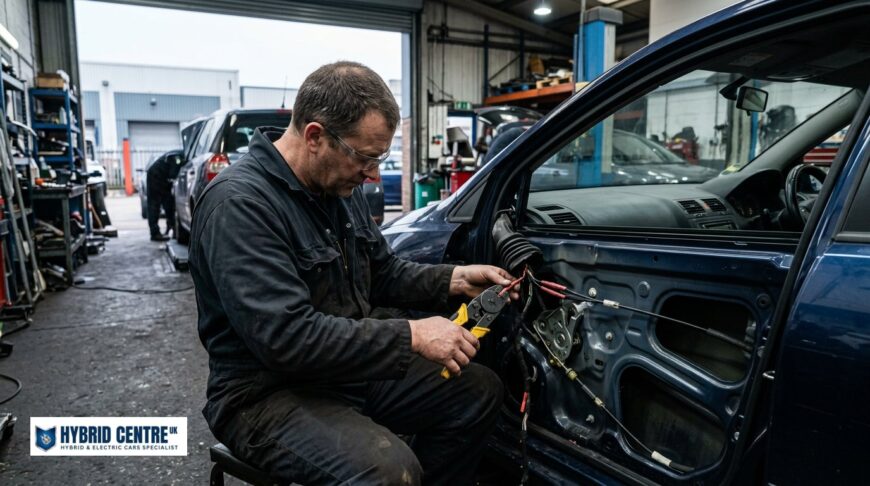
An auto electrician diagnoses and repairs faults in a vehicle’s electrical system. The work can include testing the battery, alternator, starter motor, wiring, fuses, sensors and electronic controls. If the engine won’t start, for example, testing can distinguish a weak battery from a starter or charging-system fault.
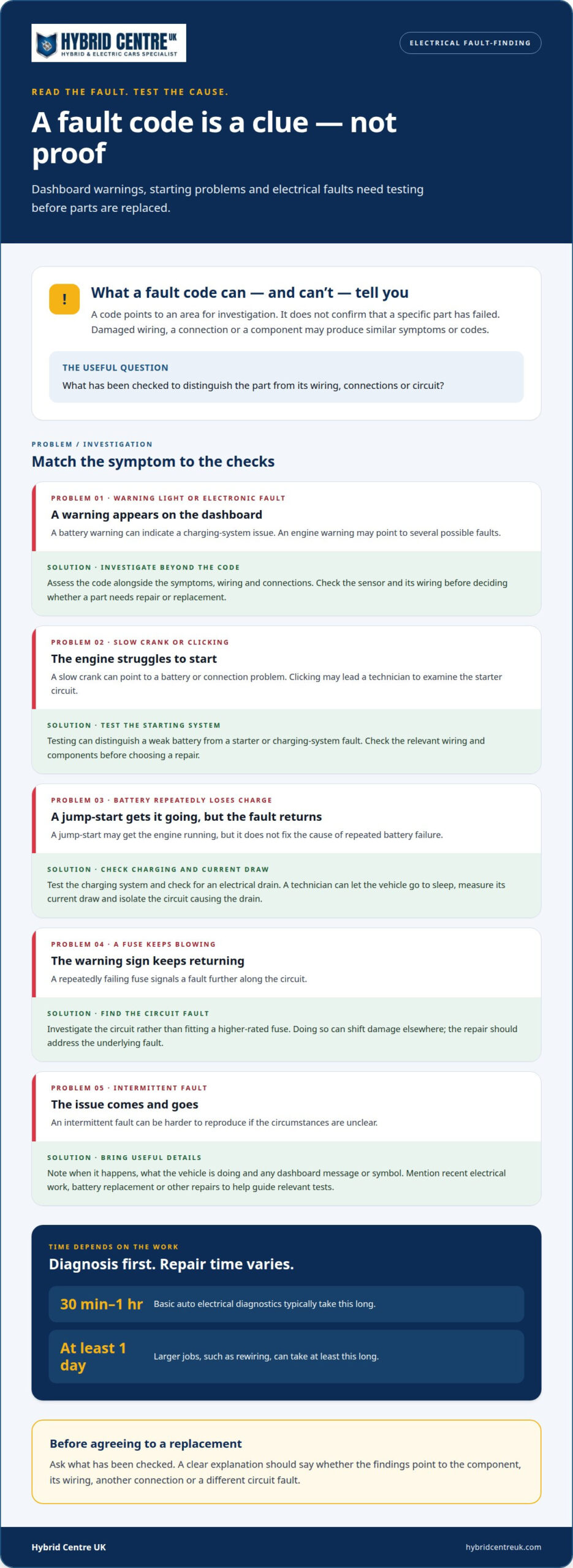
Diagnostics usually begin by recording the symptoms and checking relevant fault codes. A code points to an area for investigation; it doesn’t prove that a particular part has failed. Basic auto electrical diagnostics typically take 30 minutes to 1 hour, while larger jobs, such as rewiring, can take at least one day.
Some mobile auto electricians offer emergency jump-starts when a flat battery leaves a vehicle unable to start. This may get the engine running, but it won’t fix the cause of repeated battery failure. If the battery loses charge again, testing the charging system and checking for an electrical drain can help identify the underlying fault.
Hybrid cars need servicing that accounts for their specific systems, alongside routine maintenance. A garage may also carry out an MOT, but servicing and MOT testing are separate tasks. An MOT assesses whether a vehicle meets the required test standard on the day; a service follows maintenance needs or manufacturer instructions.
Can car electrical repairs affect an MOT result? Yes. A fault can affect the result if it prevents a tested electrical item from working as required. An electrician can diagnose and repair the fault, while the MOT test determines the vehicle’s result.
What are some of the common car electrical problems?
Dashboard warnings, failed electronic components, damaged wiring and starting problems are common reasons to seek electrical diagnosis. For car electrical repairs London garages use testing to identify the affected circuit or component before repairing or replacing it.
Warning lights and electronic faults
A battery warning light can indicate a charging-system issue, while an engine warning light may point to several possible faults. A fault code guides the investigation but doesn’t prove that a specific part has failed. A specialist uses diagnostic equipment to assess the code alongside the symptoms, wiring and connections. Damaged wiring, for example, can produce the same code as a faulty sensor.
Warranty and insurance cover depend on your vehicle’s warranty terms and insurance policy. Review the relevant exclusions and claim conditions before authorising work.
Starting and non-starting faults
A slow engine crank can point to a battery or connection problem. A clicking sound may prompt a technician to examine the starter circuit. If the battery repeatedly loses charge, testing can help identify a charging fault or electrical drain. These checks establish whether a component needs repair or replacement.
If you’re arranging car electrical repairs in London for an intermittent fault, note when it occurs and what the vehicle is doing. Before booking, record any dashboard message or symbol and mention recent electrical work, battery replacement or other repairs. For a mobile auto electrician, the location and symptoms are useful booking details, whether the vehicle is at home, work or roadside.
When a fault code points to a sensor, treat it as a prompt for further checks, not confirmation that the sensor has failed. Check both the sensor and its wiring before replacing it, because damaged wiring can produce the same code. Considering both possibilities helps focus the diagnosis on the component and its circuit.
This distinction matters when deciding what work to authorise: consider the code alongside the vehicle’s symptoms and the condition of its wiring and connections. If the cause isn’t clear, ask what has been checked before agreeing to a replacement. An explanation of whether the sensor, its wiring or another connection is involved helps you understand the proposed repair and what the findings support.
Petrol and diesel mechanical and electrical repairs
Petrol and diesel cars share core electrical components, including the battery, alternator, fuses, ground circuit and starter motor. Their engine faults can also involve different components. A petrol engine, for example, may have an ignition fault, while a diesel may have a starting or fuel-system problem. A mechanic checks the reported symptoms before deciding whether electrical or mechanical testing should come first.
If the engine turns over but doesn’t start, the garage distinguishes a starting fault from an engine-running fault. The mechanic can check stored fault codes, inspect relevant wiring and test components linked to the symptoms. A code is a pointer, not proof that a particular part has failed. This matters when an electrical reading appears alongside a mechanical problem: replacing a part without tracing the cause may leave the original fault unresolved.
If a battery repeatedly loses charge, a technician can let the vehicle go to sleep, measure its current draw and isolate the circuit causing the drain. Repeatedly blown fuses also need investigation. A fuse that keeps failing signals a fault further along the circuit; fitting a higher-rated fuse can shift damage elsewhere. The repair should address the circuit fault, not mask the warning sign.
Electrical problems can affect safety features or stop a vehicle running, and delaying diagnosis can allow damage to worsen. Describe when an intermittent fault occurs, what the dashboard shows and what the car was doing. Mention recent repairs, too. These details help a mechanic reproduce the symptoms and choose relevant tests. The key is to diagnose the full symptom before replacing parts, especially when engine behaviour and electrical warnings occur together.
Which London garages specialise in electric and hybrid vehicle repairs?
For car electrical repairs London drivers need on electric and hybrid vehicles, choose a garage with relevant diagnostic equipment and technician training. Work on a high-voltage system requires specialist equipment. A suitable garage can distinguish a high-voltage issue from a fault in the conventional 12-volt battery, wiring or charging system.
Look for technicians with relevant auto electrical training, such as IMI accreditation or an NVQ Level 3 in Auto Electrical and Mobile Electrical Principles. Ask how the garage approaches diagnosis: testing should connect warning messages with checks of components and wiring. A fault code alone doesn’t prove a component has failed. Careful fault-finding helps avoid replacing a part before identifying the cause.
Hybrid battery symptoms also need proper assessment. Reduced performance or a battery warning can have more than one cause. Testing should establish the battery’s condition before repair or replacement is considered. A garage specialising in hybrid work should explain its findings clearly, including whether the issue concerns the battery or another vehicle system.
Consider whether the garage can address related work when a fault affects more than one system. A starting problem, for example, may involve electrical controls as well as engine systems. A workshop able to assess both can support a more joined-up diagnosis. When comparing options for car electrical repairs in London, prioritise relevant hybrid experience, diagnostic capability and a clear explanation of the repair steps. These criteria give you a practical basis for choosing where to take your vehicle.
Before booking an electrical repair, car lessees should contact their leasing provider, as some providers may require repairs to be carried out by approved garages.
Hybrid Centre UK: Electrical Work
Hybrid Centre UK provides electrical work and advanced diagnostics for London drivers dealing with warning lights, starting trouble, charging issues or faults in vehicle controls. Its hybrid battery services can help assess battery warnings, reduced performance or changes in battery health. Describe the symptoms and any recent repairs so the technician can focus the investigation.
Advanced diagnostics can help identify which system needs attention before you decide on repairs. A fault code is a starting point, not proof that a particular component has failed. Testing can help distinguish a battery problem from a fault elsewhere in the electrical system. This matters because replacing a part without finding the cause may leave the original symptoms unresolved.
Electrical work may be appropriate if a warning light returns, a component stops working or the vehicle has an intermittent fault. Hybrid battery repair can address faults within the battery, while replacement may be considered when its condition calls for it. Assessment helps establish the right option for your vehicle instead of assuming every battery warning needs the same repair.
A car service may also help when electrical symptoms appear alongside routine maintenance needs. Tell the technician when the problem occurs, what the dashboard displays and whether the vehicle was recently repaired. For a hybrid, mention any changes in battery performance. These details help connect the symptoms with the diagnostic findings and guide the next repair step.
If an electrical fault or hybrid battery concern is affecting your vehicle, contact Hybrid Centre UK to discuss the symptoms.
Frequently Asked Questions
Can you fix a car that won’t start where it is parked?
A car that won’t start can be assessed for a starting or charging fault; the repair depends on the diagnosis and access to the vehicle. Hybrid Centre UK handles starting and charging repairs in London. Describe what happens when you try to start the car, such as a clicking sound, dim lights or no response, to help guide the assessment.
Dead control module?
A control module that seems unresponsive needs diagnosis before anyone decides it has failed. A power-supply issue, poor connection or wiring fault can affect its operation. Advanced diagnostics can help locate the problem and guide the next step. Depending on the findings, the repair may involve the module itself or another part of the electrical circuit.
Do I have to be there while you work?
You don’t need to be present for the technical tests, but the workshop needs access to the vehicle. Provide the keys and explain any symptoms you’ve noticed, including when they occur. Share any warning messages or details of recent work, too. Agree how you’ll receive updates while the vehicle is being assessed.
What can car electricians repair?
Car electricians diagnose and repair vehicle electrical faults, including problems with wiring, battery circuits, charging systems, starter circuits and electronic controls. They can also investigate components that have stopped working, such as a window or exterior light. Testing identifies the affected part or circuit, helping ensure the repair addresses the diagnosed fault rather than just the visible symptom.
What car electrical repair services do garages in London offer?
Car electrical repairs in London can include fault diagnosis, wiring repairs, battery and charging-system work, starter repairs and electronic testing. Hybrid battery work, servicing and MOT testing are also available. Match the service to your vehicle and fault, and make sure hybrid and electric systems are assessed with suitable diagnostic equipment.
What should you expect from car electrical repairs in London?
The work required depends on the diagnostic findings, the affected vehicle system and whether a component can be repaired or needs replacing. Hybrid Centre UK carries out electrical work and advanced diagnostics in London to identify faults and determine the appropriate repair. For hybrid battery concerns, assessment can distinguish a battery fault from an issue elsewhere in the vehicle.