
An EV warning light doesn’t automatically mean the traction battery has failed. Electric vehicle diagnostics in London can assess faults in the battery, electrical systems and related components. Hybrid Centre UK’s repair centre in Greenford offers specialist support for electric and hybrid vehicles, making it a local option for West London drivers.
It’s reasonable to want more than a fault-code reading, especially when a warning affects charging, performance or confidence in your vehicle. A thorough diagnosis combines diagnostic equipment with targeted checks of relevant components. This helps identify what needs attention and whether the issue involves the high-voltage system or another part of the vehicle.
This article explains how technicians assess high-voltage components, use diagnostic systems to investigate faults, and include diagnostics in electric and hybrid vehicle maintenance. It also covers routine checks and when a diagnostic assessment can help clarify the next repair or maintenance step.
Key Takeaways
- Understand how high-voltage cables, connectors and cooling systems are checked, and why safe working procedures matter.
- See how manufacturer diagnostic systems can help trace warning lights, electronic faults and thermal-management issues.
- Learn how diagnostics support routine electric and hybrid vehicle maintenance, including checks beyond the battery.
- Find out how battery replacement, suitable parts and mechanical repairs can help address different hybrid vehicle needs.
High-voltage cables, connectors and coolant checks
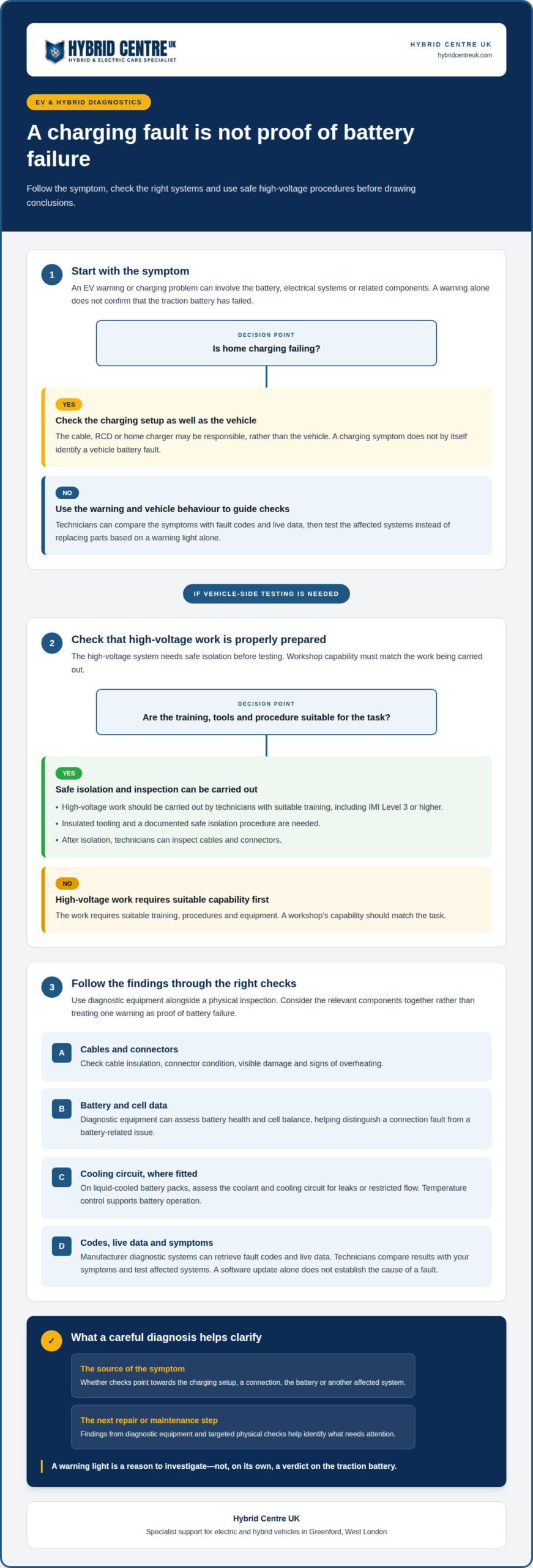
Yes. An EV diagnostic can include battery health checks and an assessment of vehicle charging faults. If home charging fails, the cable, RCD or home charger may be responsible rather than the vehicle.
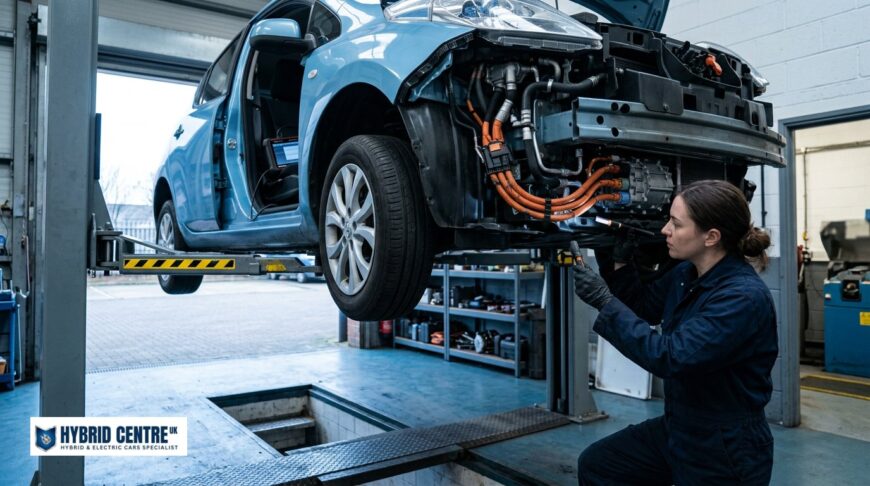
High-voltage checks can cover cable insulation, connector condition, visible damage and signs of overheating. On liquid-cooled battery packs, technicians also assess the coolant and cooling circuit for leaks or restricted flow.
Before testing, the high-voltage system needs safe isolation. London garages carrying out this work should have an IMI Level 3 or higher qualification, insulated tooling and a documented safe isolation procedure.
High-voltage vehicle work requires suitable training, procedures and equipment, with workshop capability matched to the task.
After isolating the system, a technician can inspect cables and connectors, then use diagnostic equipment to assess battery health and cell balance. These checks help distinguish a connection fault from a battery-related issue.
Coolant checks matter on liquid-cooled packs because temperature control supports battery operation. Technicians consider cable, connector and cooling-system findings together, rather than treating one warning as proof of battery failure. A software update does not replace a physical inspection of high-voltage components.
Electrical diagnosis using manufacturer systems
A main dealer or independent garage can diagnose an EV fault when its technicians have suitable training, diagnostic equipment and access to relevant manufacturer systems. The garage’s capabilities matter more than its label.
Manufacturer diagnostic systems retrieve fault codes and live data from electronic components. Technicians compare the results with your symptoms, then test affected systems instead of replacing parts based on a warning light alone. For example, an air-conditioning warning may lead to checks of thermal-management components, sensors and control signals.
EV warranty terms determine whether diagnostic work is covered. Read the warranty wording for its diagnostic and repair conditions, as coverage varies by policy.
To arrange a London appointment, provide the vehicle’s make, model and registration, along with any warning messages and details of when the fault occurs. This helps technicians prepare for the assessment.
There’s no single test duration. A stored code may be quick to assess, while intermittent electrical faults or cooling issues can require further testing. The fault’s complexity and the checks needed determine the time.
Technicians can check software status alongside sensor readings and component response. An update alone does not establish the cause of a fault.
Diagnostics as part of vehicle maintenance
Diagnostics can support routine servicing as well as fault-finding. A workshop can scan electronic systems and combine the results with a physical inspection of tyres, steering, suspension and cooling components. This can reveal stored faults and wear that may not trigger a dashboard warning.
Brakes need attention too. Regenerative braking reduces the use of friction brakes, but discs and calipers still need careful inspection and maintenance. A brake inspection can identify issues that an electronic scan alone won’t show. Tyres and cabin systems also remain part of electric vehicle upkeep.
Charging symptoms can guide further checks. If charging stops unexpectedly, technicians can assess the vehicle’s charging system and related electrical faults. An independent workshop with trained EV technicians can also carry out checks during a scheduled service, following the manufacturer’s instructions and the vehicle’s maintenance interval.
In the UK, electric vehicles need an MOT after three years, like petrol or diesel cars. Diagnostics can help investigate a warning before an inspection, while a service record helps you track completed maintenance. Warranty terms may set servicing conditions, so read them alongside the manufacturer’s schedule. For a battery concern, diagnostic findings can help distinguish a module-level repair from a wider maintenance issue.
Electric and hybrid vehicle diagnostics
An EV diagnostic check can assess the battery, electric motor, charging system and electronic controls. For hybrids, it also considers how the petrol engine and electric drive work together.
Electric vehicle diagnostics
For an electric vehicle, technicians read fault codes and live data from the battery, motor and control systems. They can assess charging faults and related electronics, then compare diagnostic results with the symptoms you’ve noticed. A vehicle that won’t start may have a fault in its 12V battery, a common cause of EV starting problems. A garage should be able to assess relevant battery-cell data, not rely only on a general state-of-health reading. Mileage and age alone don’t show the battery’s full condition. Ask what the diagnostic findings indicate, and whether software status forms part of the assessment.
Hybrid vehicle diagnostics
A hybrid vehicle needs checks across both its electric drive and petrol engine systems. Technicians assess the hybrid battery, motor, engine electronics and control systems together, because a fault in one area can affect how the vehicle operates. A warning light may relate to the engine, battery or another electronic component, so diagnosis should identify the system involved before repairs begin. For hybrid and electric vehicles, choose a garage with trained EV technicians and equipment suited to the vehicle. The key point is that diagnostics should assess the relevant systems as a whole, rather than treat every warning as a battery fault.
Hybrid battery replacement and parts
A hybrid battery warning does not automatically mean the whole battery needs replacing. Diagnostic findings help identify whether the fault is within the battery or another part of the vehicle’s electrical system. The vehicle’s make, model and battery condition inform the next step. Hybrid battery replacement is appropriate when the diagnosis identifies replacement as the required repair.
Hybrid batteries and parts need to suit the vehicle they’re being fitted to. Differences between makes and models mean the part must match the vehicle’s requirements. Hybrid Centre UK supplies hybrid batteries and car parts for different hybrid vehicles, supporting repair and replacement work across a range of applications.
Replacement work involves more than fitting a battery. Technicians assess the fault, select a suitable part and carry out the work with care for the vehicle’s electrical systems. After installation, diagnostic checks help assess system operation and identify any remaining faults. This connects the initial diagnosis with the completed repair.
If your hybrid shows reduced performance or a battery warning, accurate diagnosis helps establish whether repair or replacement is needed. Base the decision on the vehicle’s condition and compatible parts, not on a warning light alone.
Mechanical work for electric and hybrid vehicles
Electric and hybrid vehicles still need mechanical attention alongside electronic checks. A brake inspection assesses pads, discs and calipers, while technicians inspect tyres, steering and suspension for wear or damage. Regenerative braking can reduce friction-brake use, so brake components still need condition checks even when braking feels normal.
A vehicle service can include a fluid level check and inspection of cooling components. On a hybrid, technicians may assess engine operation and related mechanical systems alongside the electric drive. An engine oil and filter change follows the manufacturer’s instructions and the vehicle’s maintenance interval. These checks can identify mechanical issues that a diagnostic scan alone may not reveal.
Mechanical repairs can address faults in the engine, gearbox, brakes and suspension. Technicians assess the affected component, carry out the required repair and check its operation. For example, a brake concern calls for inspection of the relevant components, not just an electronic fault-code reading. Combining mechanical assessment with electrical findings gives a clearer picture of your vehicle’s condition and maintenance needs.
Hybrid Centre UK: Advanced Diagnostics
Hybrid Centre UK provides Advanced Diagnostics for electric and hybrid vehicles when warning lights, charging problems or unexplained changes need investigation. Technicians use diagnostic equipment to read system information and narrow down possible faults, helping distinguish a stored code from the issue affecting your vehicle.
Electrical Work supports fault-finding across vehicle electrical systems and components. Diagnostic findings help identify where further inspection or repair may be needed, whether the concern involves a sensor, control system or another electrical component. This gives you a clearer understanding of the fault and the work involved.
If findings point to a hybrid battery fault, Hybrid Centre UK’s Hybrid Battery service can address the battery-related issue. A Car Service can also support routine maintenance while a reported problem is investigated. The appropriate work depends on your vehicle’s symptoms and diagnostic results.
When arranging an assessment, share the vehicle’s make and model, any warning message and when the problem occurs. For example, note whether a charging issue happens at home or a warning appears during a journey. These details help technicians understand the concern and focus their checks.
For electric vehicle diagnostics in London, contact Hybrid Centre UK to discuss your vehicle’s symptoms and arrange an assessment.
Frequently Asked Questions
Does the network have a garage in London?
Yes. Hybrid Centre UK operates from 44 Bideford Ave, Perivale, Greenford UB6 7PP. The London site handles hybrid and EV repairs, as well as MOT and servicing work. Its opening hours are Monday to Friday, 9:00 am to 6:30 pm, and Saturday, 9:00 am to 5:00 pm. It is closed on Sunday.
What qualifications should a garage have to work on my EV or hybrid?
For high-voltage work, the technician carrying out the task should have an IMI Level 3 or higher qualification. Make sure the qualification relates to the person doing the work, rather than relying on a garage’s general experience with cars. The task matters too: routine servicing and work on high-voltage components call for different specialist skills.
Where can I get electric vehicle diagnostics in London?
Hybrid Centre UK provides electric vehicle diagnostics in London at its repair centre in Greenford. The workshop handles hybrid and EV repairs and can assess electrical or mechanical concerns. When arranging an assessment, provide the vehicle’s make and model and describe the fault, such as a warning that appears only after charging.
Which London garages diagnose all EV makes and models?
Hybrid Centre UK is a London hybrid and EV repair specialist. Its hybrid battery repair work covers all makes and models. That describes its hybrid battery capability, rather than a claim that every service covers every vehicle. If your concern is battery-related, share your vehicle details and symptoms so the repair team can direct the assessment appropriately.
What should I do if my EV shows a warning light or loses power?
Record the exact warning message and note when it appears, such as after charging or during a journey. If the vehicle loses power, describe what happened as a separate symptom, rather than reporting only the dashboard light. Clear details help technicians understand the sequence of events and focus their investigation.
Are London EV diagnostic garages certified to work on high-voltage systems?
Not every garage should be assumed to have high-voltage competence simply because it diagnoses EVs. For work on high-voltage systems, the technician doing that task should hold an IMI Level 3 or higher qualification. This requirement relates to high-voltage work; it does not mean every diagnostic check involves those components or procedures.