
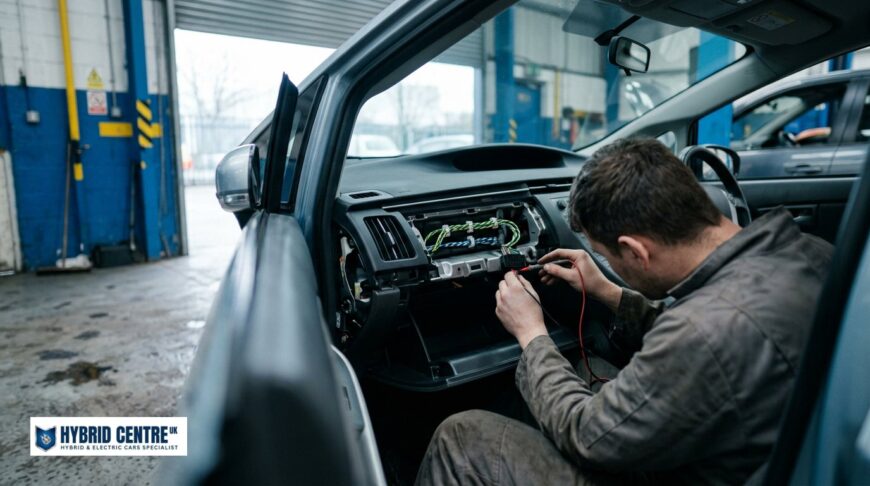

A diagnostic trouble code points to a system or circuit where a fault has been detected, but it doesn’t prove which component has failed. Effective car electrical fault diagnosis combines code interpretation with electrical and physical testing to trace the underlying cause. This guide explains how technicians assess warning lights, investigate CAN bus faults and choose diagnostic equipment suited to the vehicle.
Key Takeaways
- Treat diagnostic codes as a starting point: further electrical testing helps identify the underlying fault before parts are replaced.
- See how scanners, multimeters and other diagnostic equipment help technicians test circuits and verify repairs.
- Learn why warning lights, dimming lamps or several alerts together can point to an alternator or wider voltage supply issue.
- Understand how network and hybrid battery faults are assessed, and when specialist electrical work or battery support may be appropriate.
How do professionals diagnose vehicle electronic faults effectively?
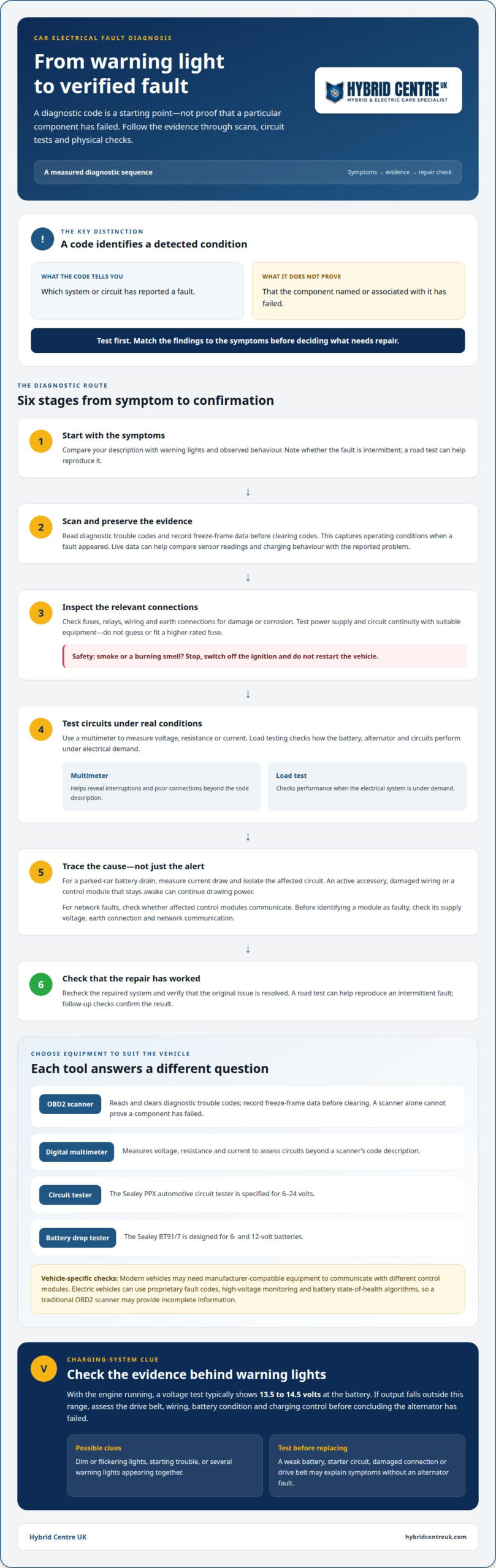
A structured car electrical fault diagnosis links symptoms to scan data, circuit tests and physical findings. A road test can help reproduce an intermittent fault, and follow-up checks show whether the repair has resolved it.
Systematic Electrical Fault Testing
Technicians compare your description with warning lights, stored codes and observed symptoms. A main dealer may be suitable when a fault requires manufacturer-specific systems, while an independent garage or auto electrician can also diagnose faults with the right equipment. The best approach depends on the vehicle, the symptoms and the systems that need testing. A road test can help reproduce the issue before the technician checks the repaired system again.
Circuit and Load Testing Methods
A multimeter measures voltage, resistance or current to reveal interruptions and poor connections. Load testing checks how the battery, alternator and circuits perform under electrical demand. Diagnostic testing provides fault codes and supporting data, but a code points to a system or circuit, not necessarily a failed component. Technicians consider these results together before deciding which repair is needed.
Safe Checks of Fuses and Wiring
Technicians inspect relevant fuses, relays, wiring and earth connections for damage or corrosion. They use appropriate equipment to test power supply and circuit continuity, rather than guessing or fitting a higher-rated fuse. Wiring looms, control units, airbags and charging circuits require professional handling. If you notice smoke or a burning smell, stop, switch off the ignition and do not restart the vehicle.
Finding Parasitic Battery Drain
A parasitic drain occurs when a circuit continues to draw power while the car is parked. An active accessory, damaged wiring or a control module that stays awake can cause it. For intermittent symptoms, car electrical fault diagnosis includes measuring current draw and isolating the affected circuit. Technicians then verify the repair and check whether the battery continues to hold its charge.
Diagnostic tools professionals use for car electrical faults
Professional diagnostic equipment helps a mechanic connect a symptom to the vehicle components involved. An OBD2 scanner reads and clears diagnostic trouble codes, but technicians should record freeze-frame data before clearing them. This information captures operating conditions when a fault appeared. Live data can then help compare sensor readings and charging behaviour with the reported problem.
A digital multimeter measures voltage, resistance and current, helping technicians assess a circuit beyond the scanner’s code description. For example, a Sealey PPX automotive circuit tester is specified for 6-24 volts. A Sealey BT91/7 battery drop tester is designed for 6- and 12-volt batteries. Each tool answers a different question, so readings need to be interpreted alongside symptoms and inspection findings.
Modern vehicles may need manufacturer-compatible equipment to communicate with different control modules. A traditional OBD2 scanner can provide incomplete information for electric vehicles, which use proprietary fault codes, high-voltage monitoring and battery state-of-health algorithms. A scan tool alone may therefore miss evidence that specialist equipment can access. The mechanic selects tools according to the vehicle and the systems showing faults.
The key point is that no single scanner proves a component has failed. A code identifies a detected condition; multimeter readings, battery tests and physical inspection help establish its cause. Diagnostic equipment should support a measured testing process, not trigger parts replacement based on a code alone. For an accurate diagnosis, the technician matches each result to the symptoms and checks that the evidence is consistent.
Alternator operation and warning lights
The alternator converts engine power into electrical energy and recharges the battery while the engine runs. A voltage test typically shows 13.5 to 14.5 volts at the battery with the engine running. If output falls outside this range, technicians assess the drive belt, wiring, battery condition and charging control before concluding the alternator has failed. Added electrical load can expose weak output. Dim or flickering lights and starting trouble are common clues.
An MOT inspection can identify problems with required lights and some warning indicators, but it does not trace every electrical fault. Separate diagnostic testing is needed to find the cause. Several warning lights appearing together may point to a voltage supply problem rather than multiple failed components.
A weak battery can cause clicking or difficulty starting, and a battery test helps assess its condition. If the battery tests well but charging voltage is low, the alternator or its circuit needs investigation. A starter fault can also cause clicking or a failed start, so technicians test the starter circuit rather than relying on symptoms alone.
Whether to repair or replace a component depends on the test results. A damaged connection or drive belt may explain poor charging without requiring an alternator replacement. If the alternator itself cannot produce the required output, replacement may be needed. After repairs, technicians check charging performance under electrical load, confirm that warning lights have cleared and verify that starting is back to normal.
CAN bus and vehicle-network faults
A CAN bus allows electronic control units to exchange information across a vehicle’s electrical system. Modern vehicles can contain dozens of control units connected by hundreds of metres of wiring. A communication fault can prevent several components from working correctly, even when each component appears intact.
Several warning lights appearing together can indicate low system voltage, damaged wiring, a shared sensor fault or lost communication between modules. Water ingress can corrode connections and damage wiring, sensors or control units. These faults may cause intermittent symptoms, such as warning lights that come and go or equipment that works inconsistently.
Diagnosis involves scanning the affected systems and checking whether the modules communicate. Before identifying a control unit as faulty, a technician checks its supply voltage, earth connection and network communication. This helps distinguish a failed module from a communication fault or poor connection. Physical inspection can then help locate damaged wiring, corrosion or signs of water ingress.
Before diagnosis, note which warning lights appeared, what stopped working and when the issue occurs. Tell the technician whether symptoms happen during starting, while driving or after rain. Mention recent repairs or signs of water ingress, as these details help focus the tests. If the fault is intermittent, describe what changes when it appears. That pattern can help reproduce the problem and narrow down the affected network or circuit.
Hybrid battery faults and replacement
A hybrid battery warning does not automatically mean the battery pack needs replacing. Electrical diagnosis checks stored fault codes alongside battery-management data and related system readings. A technician assesses whether the evidence points to battery degradation, a sensor issue, a connection fault or another electrical problem. This helps avoid treating a warning as proof that a component has failed.
Traditional OBD2 scanners can provide incomplete information for electric vehicles, which may use proprietary codes, high-voltage monitoring and battery state-of-health algorithms. Hybrid battery diagnosis therefore needs equipment and data suited to the vehicle. A code is a starting point; technicians interpret it with live readings and physical inspection to establish what is affecting battery performance.
Repair may be appropriate when testing identifies a fault that can be addressed without replacing the battery. If tests show that the battery has degraded or can no longer perform as required, hybrid battery replacement may be suitable. The decision depends on test results, battery condition and the underlying cause, not on a dashboard message alone.
Professional hybrid battery repair can help establish whether the issue is within the battery or its supporting electrical systems. Technicians assess relevant codes and readings before recommending repair or replacement. A warning can relate to battery management, thermal regulation or a high-voltage circuit, so a clear diagnosis links the symptoms to the affected system and supports an evidence-based repair decision.
Hybrid Centre UK: Electrical Work
Hybrid Centre UK provides electrical work and advanced diagnostics for faults affecting starting, charging, lighting, wiring and vehicle networks in London. Technicians use diagnostic equipment and electrical tests to trace the cause, rather than treating a warning code as proof of component failure. This helps distinguish a battery, connection or circuit issue from a wider system fault.
Testing can include reviewing stored codes, checking relevant circuits and inspecting components linked to the reported symptoms. After repairs, technicians verify that the affected system works and check whether the original warning or fault remains. This is particularly useful when a fault is intermittent, affects several electrical functions or returns after an earlier repair.
Hybrid Centre UK also investigates hybrid battery faults through its Hybrid Battery service. Diagnosis helps establish whether symptoms relate to battery performance or another part of the vehicle’s electrical system. Car Service can address wider maintenance needs alongside the investigation when the symptoms or vehicle condition call for a broader assessment.
Consider professional diagnosis if warning lights persist, the vehicle repeatedly struggles to start, electrical equipment behaves inconsistently or a hybrid battery alert appears. When arranging an assessment, describe the symptoms, when they occur and any recent repairs. These details help technicians focus their testing on the systems most closely linked to the fault. For electrical or hybrid battery concerns, get in touch with Hybrid Centre UK.
Frequently Asked Questions
How do professionals interpret diagnostic codes correctly?
Professionals treat a code as a clue and compare it with symptoms and test results. A professional car electrical fault diagnosis may investigate a P0336 crankshaft position sensor code by checking its signal and related components. Possible causes include a damaged reluctor ring, wiring fault, poor earth connection or failed sensor. The code alone doesn’t identify which cause applies, so testing guides the repair decision.
How do you know if there’s a problem?
Changes in starting, lighting or electrical equipment can signal a fault. Note whether the engine turns slowly, dashboard gauges behave erratically or a warning light appears alongside dim headlights. Record when the symptoms occur, such as after parking overnight or during a journey. Smoke or a burning-plastic smell needs urgent attention: stop, switch off the ignition and do not restart the vehicle.
How does the professional step-by-step fault-finding process work?
A technician starts by recording your symptoms and any conditions linked to them, then selects tests for the affected systems. During car electrical fault diagnosis, an intermittent fault may need to be reproduced under similar conditions before its cause becomes clear. The technician compares the findings, completes the relevant repair and checks whether the original symptom returns during verification.
What are some of the common car electrical problems?
Common problems include a battery that repeatedly goes flat, failed lights, damaged wiring and blown fuses. A sticking accessory or control module that stays active can also drain a battery while the vehicle is parked. A lamp that does not work, for example, could have a faulty bulb, fuse, wire or connection. Identifying the affected part of the circuit helps avoid replacing unrelated components.
What are the major components in a car’s electrical system?
Key components include the battery, alternator, starter motor and wiring circuits. Modern vehicles also have electronic control units and sensors that manage functions such as engine operation and braking. A hybrid has high-voltage components alongside conventional electrical equipment. Because these parts interact, a fault in one area can affect another system or cause symptoms elsewhere in the vehicle.
What can car electricians repair?
Auto electricians can diagnose and repair faults involving wiring, charging systems, starting circuits, lighting and electrical connections. This may include tracing a damaged wire that interrupts power to a component or investigating a charging fault. Hybrid electrical issues can involve battery systems and related controls. In London, Hybrid Centre UK provides electrical work, advanced diagnostics and hybrid battery services for relevant vehicle faults.